What Foods That Makes Your Teeth and Gums Healthy and Strong

Foods Make Teeth Stronger
What Foods That Makes Your Teeth and Gums Healthy and Strong

We consume different types of food items daily as per the availability, our taste or preferences and of course, as per the affordability. However, a few food items are very common, consumed by most people in our society and also essential for our body. While health-conscious people prefer to eat some food additionally as per their body requirements or keep their particular organ healthy.      

Teeth are one of the most vital parts of our body that also require certain nutrition to keep them strong and healthy. And to keep your teeth and gums healthy, apart from oral hygiene and dental care, you also need to add some extra foods to your diet to keep them strong.  Today, here we are going to discuss about the food that makes your teeth healthy and strong with eating tips.

What Foods Make Teeth Stronger?

As per the dental association across the nations, calcium, vitamin D, and phosphorus-rich foods are good for the health of teeth and gums. These minerals and vitamins help in more saliva production while reducing acidity in your stomach, helping you to strengthen your teeth’s health.

To fulfil the extra requirements of these vitamins and minerals, you need to consume some additional foods such as dairy products, leafy greens, nuts, and certain fruits, which are rich in vitamin D and calcium. Below you can find the food that contains these minerals and vitamins, keeping your teeth and gums healthy.     

Food that makes your Teeth and Gums Strong:
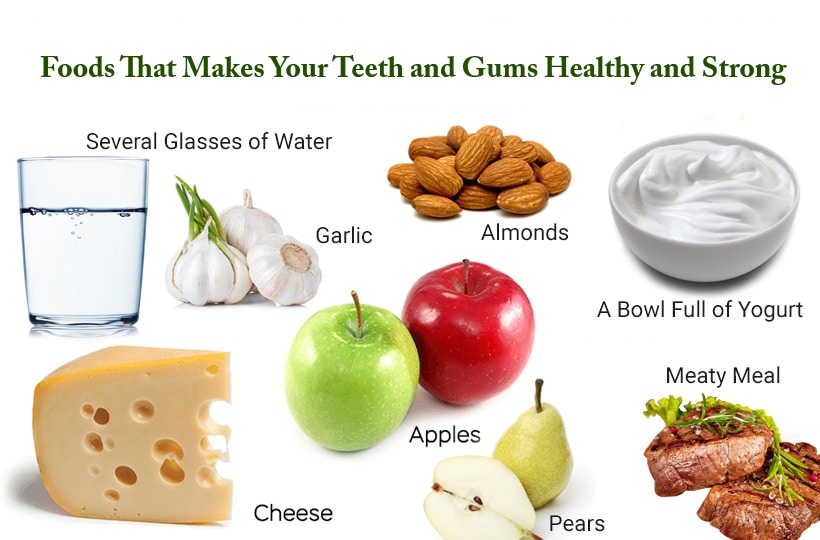
Milk or Dairy Products

Dairy products like milk, yoghurt and cheese are a rich source of calcium, which is one of the most essential minerals to keep your teeth healthy and strong. Apart from this, these milk products also contain the casein protein, which stabilises and repairs the enamel of your teeth.

Cheese contains calcium that not only maintains the density of bones but also lowers the acid levels in the mouth, which helps your teeth to fight tooth decay. However, cheese is also rich in phosphate content, which helps balance PH levels in the mouth, helping to preserve tooth enamel.

Almonds and Nuts

Almonds and other nuts are a good source of calcium and protein with low sugar content. Apart from that, peanuts and other nuts are a great source of calcium and vitamin D, keeping your teeth strong. While cashews help to stimulate the saliva and fight with bacteria that lead to tooth decay. 

On the other hand, walnuts contain multiple minerals and vitamins like magnesium, potassium, zinc, iron, folic acid, fibre, niacin, thiamine, vitamin E and vitamin B6. And one of the best parts is that eating dry fruits or nuts helps you to scrape off plaque when you chew them with strong bites.

Carrots and Green Salads

Eating raw carrots not only acts like a natural toothbrush, cleaning your teeth, but also reduces the risk of cavities due to increased saliva production in your mouth by chewing them. Along with high fibre content, carrot also contains Keratin and vitamin A, helping you to repair the enamel.

Also Read: How to Protect Teeth from Cavity Growing and Getting Worse

Similarly, other raw salads are rich in fibre, and vitamin A improves the health condition of your gums with blood circulation. Apart from this, carrot also contains Vitamin K1, biotin, and keratin, which are good for keeping your jawbones and gums healthy while strengthening the enamel.

Spinach and Leafy Vegetables

Spinach is enriched with nutrients like folic acid, calcium and vitamin K that contribute to healthy and strong teeth and gums. These vitamins and minerals in spinach also help to strengthen the teeth enamel and promote gum healing while reducing any kind of inflammation in gums and teeth.

Similarly, other green and leafy vegetables also contain vitamins, iron and calcium, helping the rebuilding of enamel and keeping your teeth strong and healthy. And some of the green leafy vegetables contain antioxidants that reduce the acidity in your mouth and help to fight harmful bacteria, protecting your teeth and gums against cavities and other diseases. 

Also Read: How to Get Rid of Tooth Decay: Natural Ways Remove Cavities

Apples and Fruits with Vitamin C

To eat an apple, you need to bite and crush it with your teeth; this process helps to clean your teeth like a natural toothbrush. Chewing apple produce salvia that helps to manage acidity in your mouth and wash away the food particles, working like a natural dental care product.

Similarly, other fruits such as strawberries, pineapple, cranberries, kiwi and other citrus fruits like oranges and lemons are good for teeth and gums. Strawberries work like a natural teeth whitener, pineapple is rich in manganese and calcium, while kiwi and citrus fruits are enriched with vitamin C.

Similarly, cranberries reduce plaque formation, and blueberries and raspberries are rich in anthocyanins, preventing pathogens from attaching to teeth, keeping them strong and healthy. Raisins – a dry fruit, contain phytochemicals that kill bacteria and prevent gum disease.   

Salmon and Other Fatty Fish

Salmon is one of the richest sources of omega-3 fatty acids, with a good amount of vitamin D and phosphorus. Omega-3 fatty acids help to reduce inflammation in the gums and prevent other related diseases. On the other hand, Vitamin D helps to absorb the calcium in our body, which is a key component to keep our teeth strong. And phosphorus builds and maintains strong teeth.  

Similarly, other fatty fish also contain the same types of nutrition along with fatty acids that are not only good for the brain and cognitive functioning. These fatty acids also act as powerful inflammation, supporting the immune system, which also helps to prevent gum-related diseases.

Summing-up

Foods rich in Vitamin D, calcium, and Vitamin C are not only good for your teeth but also play a major role in keeping your teeth strong and healthy. However, food items that contain magnesium, potassium, phosphorus, fatty acids, folic acid, fibre, niacin, thiamine, vitamin E, and vitamin B6 also help to keep your teeth healthy and free from germs and bacteria that are harmful to your teeth.

Apart from consuming these food items, you also need to take care of your teeth with proper oral hygiene and dental care. However, despite such care in case of any dental problem or gum-related diseases, you can visit your nearest Dental Clinic in Greater Noida. You can book appointment online at Dr. Sinha Dental Clinic and get one of the best treatment and care facilities for all types of dental problems.
When to Get Dental Implants or after Tooth Extraction?

after Tooth Extraction
When to Get Dental Implants or after Tooth Extraction?

Removal of teeth could be one of the most embarrassing phases of your life. You not only feel the pain during this dental procedure but also face problems like chewing or feeling awkward while opening your mouth or smiling confidently in public places, especially while talking with others.    

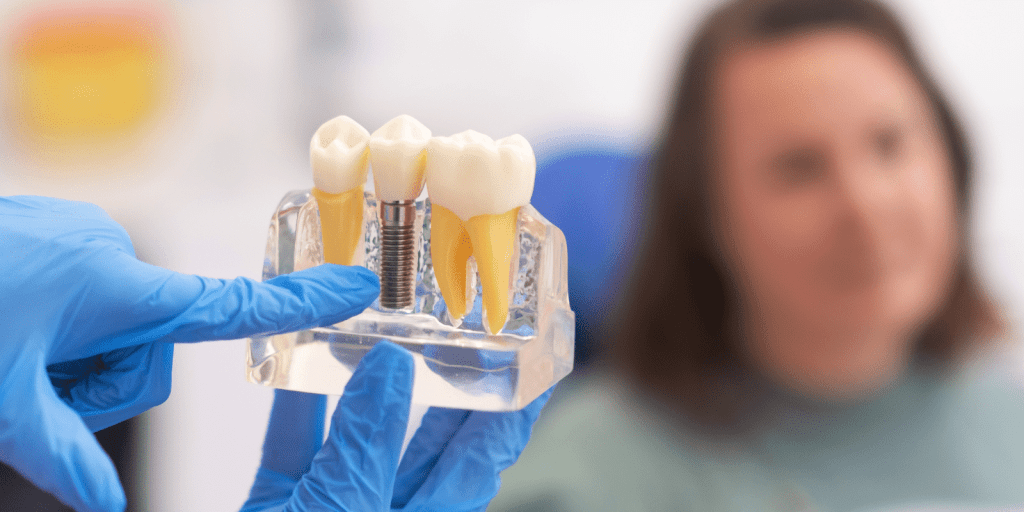
However, with the help of advanced techniques in dentistry, you can get artificial teeth through implant procedures. But the question here is it is possible to get new teeth through dental implants immediately after tooth extraction, or how long it takes to get implants after teeth removal. So, right here, we are going to discuss about various aspects of getting dental implants after tooth extraction.    

Precautions to Take After Tooth Extraction

Tooth extraction is a surgical process in which a dentist cuts through the gums and extracts the tooth from its roots, and also cleans the remaining parts and the infected area. After removing the tooth, the healing process starts with the medicines and other precautions to avoid infections and healing wounds. 

In fact, after tooth extraction, your mouth and gums become injured, and there is some bleeding during the removal. To recover from these wounds, you need to take various precautions like avoiding certain foods, eating some specific foods and also maintaining oral hygiene while avoiding any further dental surgery for the next few days or months, depending on your mouth condition and healing process.   

Can you get a Dental Implant Immediately after a Tooth extraction?

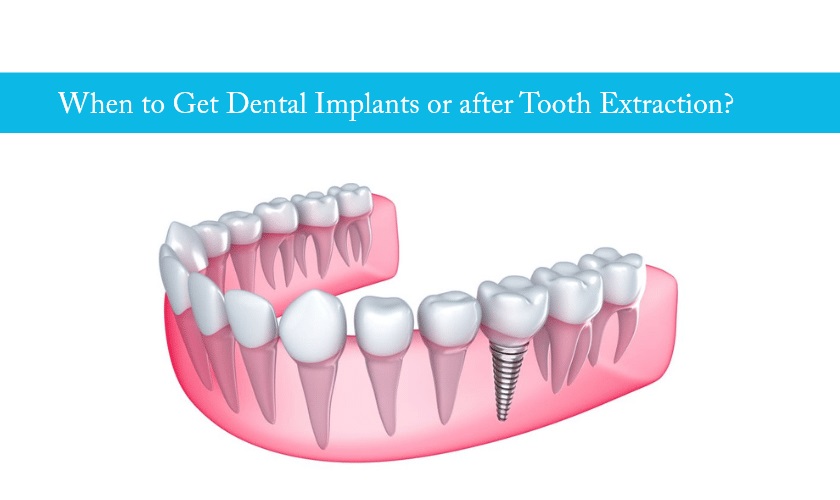
Though it is not recommended to get the implants immediately after the teeth extraction, but if you have a strong jawbone and healthy gums, you can get the new teeth through implants. The implantation also depends on how severe your wounds are after tooth extraction; if the removed teeth don’t have much impact on your gums and jawbones, then you can easily undergo the implants after tooth extraction. 

Also Read: Why Dental Implants Are Important and its Benefits?

However, in various cases, getting the immediate implants after the tooth extraction could be risky, especially if you have removed your molar tooth with strong roots and took time and lots of effort in the extraction. Here, you need to wait till your surgical area heals and is able to handle the new surgical process.

why dental implants are important

However, you can try for early implants, which are usually performed after two or three months after tooth extraction. In most cases, it can be easily performed as the gums and affected area heal, with the ability to face new surgical processes or other dental procedures like implants.

And the last one of the safest implants after tooth removal is delayed implants, in which the dentist performs the dental implant procedure after three months. During this extended period, most of the surgical processes in the mouth or gums are naturally healed, especially if no infection occurred during this period. In delayed implants, your jawbones become strong enough to tolerate a new dental procedure. 

Factors Affecting Dental Implants after Tooth Extraction

Taking the implants after tooth extraction depends on various factors, and depending on your body condition, recovery capability and other circumstances, you can make the right decision. Below you can find the factors influencing dental implants after tooth extraction.

Health Condition: The health condition of the patient, including teeth, bone density and healthy gums, is the main factor on which implants can be performed. 

Position of Teeth: Compared to incisors and premolars, molar teeth with multiple roots need more time to heal and can be treated with delayed implants.

Impact of Extraction: At the time of a severe surgical process, it has a deep impact on the gums and roots where the tooth has been extracted, and it also takes more time to heal, delaying the dental implants. 

Level of Infection & Recovery: Any kind of infection that persists around the tooth extraction area does not allow any kind of implants until the infection is completely gone from your mouth. 

Maintaining Oral Hygiene: Few people take care of their mouths or teeth, and a lack of oral hygiene is not suitable for getting dental implants, especially after a tooth extraction. 

Strength of Jawbones and Gums: The strength of the patient’s jawbone and gums also signifies which kind of dental implants can be performed after the tooth extraction.  

Process and Expertise of the Dentist: Last but not least, it also very much depends on the knowledge, experience, expertise and capability of the dentist to do the implant immediately or later on. 

Side Effects of Early Implants After Tooth Extraction

As we already said, early dental implants can be risky; you can face various health problems like pain and discomfort or swelling and bleeding in your teeth. There is a high probability of infection due to earlier wounds from tooth extraction that can cause serious problems.

Other side effects could be that the implants can become unstable or the entire procedure can fail. Furthermore, you could face sinus issues, in which implants can sometimes swell into the sinus cavities. And in the worst condition, the nerve could be permanently damaged, causing numbness, tingling, or pain in the lips or gums, tongue and chin, making your life difficult. 

Benefits of Implants after Tooth Extraction 

Dental implant after tooth extraction is not only important to get the new teeth but also prevents the loss of your jawbones and entire tooth structure. Another benefit of implants is that they restore your chewing function and prevent further tooth shifting with a long-term solution for missing teeth.

In some cases, implants can be placed immediately after the tooth extraction, allowing the patients to get new teeth after extraction. And it also improves speech and enunciation, giving you the natural look and feel, improving your overall smile and facial expressions.   

How long after Tooth Extraction can you Get Dental Implants?

After tooth extraction, the dental implants can be placed depending on your jawbone’s condition and the level of recovery from the surgical process. Though you can opt for immediate, early or delayed implants, but your dentist can tell you better as per the location of the tooth and the strength of the bone or health of the gums. 

However, the best time to get dental implants is 3-6 months after the tooth extraction. During this period, most of the cuts and infections due to tooth extraction healed, allowing the patients to get any other oral treatment without risk of complications. And to know how long after tooth extraction, you can get dental implants, you should visit Dr. Sinha Dental Clinic, providing one of the best and most effective Dental Implant Services in Greater Noida with the highest success rate in the town.

How to Prevent Grinding Teeth While Sleeping: Home Remedies

remedies to stop grinding teeth at night
How to Prevent Grinding Teeth While Sleeping: Home Remedies

Teeth grinding, especially at during the sleep, is a mouth disorder, and in dentistry it is better known as “Bruxism”. Though, it is not a critical disorder, but it can be disturbing for people sleeping around you and also stressful for the people suffering from this problem. 

Hence, understanding this problem is necessary to take the right action to prevent it with home remedies or other treatment procedures. If you are one of them having Bruxism or suffering from a teeth clenching problem, you should read this article for remedies to control this habit and how to reduce the side-effects of teeth grinding with some of the preventive measures.  

What is Teeth Grinding or Clenching?

Teeth grinding or Teeth Clenching are both interchangeable words called bruxism, a kind of mouth disorder in which a patient keeps clenching the teeth when in deep sleep. This process runs mainly when the patient is unconscious or doesn’t know while grinding their teeth.                 

People suffering from this disorder do this regularly during sleep, and regular or hard teeth clenching can cause jaw pain, headaches, and dental damage. Hence, you need to take care of this problem and apply some of the remedies to prevent this problem. Below, we have brought here the best preventive measures to stop teeth grinding and clinching problems. 

Preventive Tips & Home Remedies for Teeth Grinding  

remedies to stop grinding teeth at night

Reduce Your Stress and Depression  

Taking too much stress and anxiety is one of the biggest reasons behind teeth grinding. Excessive stress in the life will push you into depression which can cause other health issues like acid reflux and sleep disorder or stress and depression related other health issues.  

Hence, you need to control stress and depression levels to avoid such health problems, including teeth grinding, to keep your teeth strong and healthy. If you are coping with stress or depression, you need to go to cognitive behavioural therapy (CBT) and also start yoga and meditation to deal with it. It will help you relax your mind and recover from other related problems.     

Stop Chewing Non-Edible Items      

This is one of the most common bad habits among people who also suffer from the teeth-grinding problem. Yes, a few people have the habit of chewing or biting non-food articles like pencils, pens or other handy articles in their office, school or other areas where they spend their daily life. This kind of bad habit also causes the teeth-grinding disorder among people.

In day time when you do this, it stretches your muscles and encourages you to do the same at during sleep. While some of the people also regularly enjoy chewing gums in their mouths, which also leads to a teeth-grinding problem when they sleep at night. 

Jaw Exercise to Relax Mouth Muscles 

Another way to get rid of the teeth grinding problem is you should do the jaw exercise to relax the muscles of the mouth. Teeth grinding regularly and with high pressure can disturb your jawline, while a relaxed jaw allows the whole area to rest, reducing the risk of any complications down the line. 

To do this exercise, you simply need to open your mouth wide open at the same time touch your tongue with your front teeth. Another way is to try to say the letter “N” loudly, which will keep your top and bottom teeth away from each other and help you to reduce the clenching problem. 

Use Night Guard While Sleeping                              

Night guard or mouth guard and splints are also one of the most effective ways to prevent teeth grinding at night. When you put this into your mouth, it creates a kind of physical barrier between your lower and upper jaw teeth that also protects your teeth from wear off.

Wearing a mouth guard also protects your jaw fromstrain, and when you clinch your teeth, there is no noise that comes from the mouth. It can be expensive to use the night guard, so you can use a plastic made that can be very effective, especially to prevent your teeth from wearing off. 

Get Feedback from Your Sleeping Partner  

To understand the level and type of grinding in your teeth that usually occurs after sleeping, you need to get feedback from the person sleeping beside you. It could be your life partner, living partner or friend sharing a room or bed with you who can hear or watch your teeth grinding activities.  

Here you can suggest to your partner that you nudge them whenever you clench your teeth or make such a noise. Or you can also go through the Biofeedback therapy, in which you can learn how to control your jaw through muscle movements using visual, vibratory, or auditory feedback created through electromyography. This therapy is effective in providing the relief from teeth clenching.

Treatment for Teeth Grinding and Clenching

Though home remedies can help you prevent teeth grinding, sometimes it not work for many people. And to get rid of this mouth disorder, you should go through the medical treatment that can cure the clinching problem through various other dental procedures.

Here, your dentist will suggest non-steroidal anti-inflammatory drugs that will help you get relief from pain or swelling around your jaw caused by grinding. Here you should keep relaxing your jaw muscles before going to sleep at night. To get the right treatment for teeth grinding, you can visit your nearest dentist in Greater Noida and get rid of this disorder.

Top 10 Frequently Asked Questions on Composite Tooth Filling

Top 10 Frequently Asked Questions on Composite Tooth Filling

Compositeis another popular dental procedure performed by dentists across the world to save a cavity-infected tooth. Though also critical, the procedure requires professional knowledge and experience to examine the infected tooth and complete the treatment without any issue.  

If you are seeking to get a composite filling and have several questions arising in your mind, then you have landed at the right place. We brought here the top 10 frequently asked questions on composite tooth filling with the best suitable answer for each question, helping you to understand the various aspects of this dental procedure. 

10 FAQs on Composite Tooth Filling:

FAQs on Composite Filling

Q. 1.  What is a Composite Dental Filling?

Ans. Composite filling is a dental procedure to fill specific material in the cavity infected tooth to restore its strength and functionality. The dentist performs this process and uses a material called resins that are one of the best substitutes for traditional amalgam fillings. This is simply a process of filling a suitable material in hollow teeth affected due to a cavity to stop further decay.  

Read: What is a Composite Filling?

Q. 2. How Composite Fillings are Done?

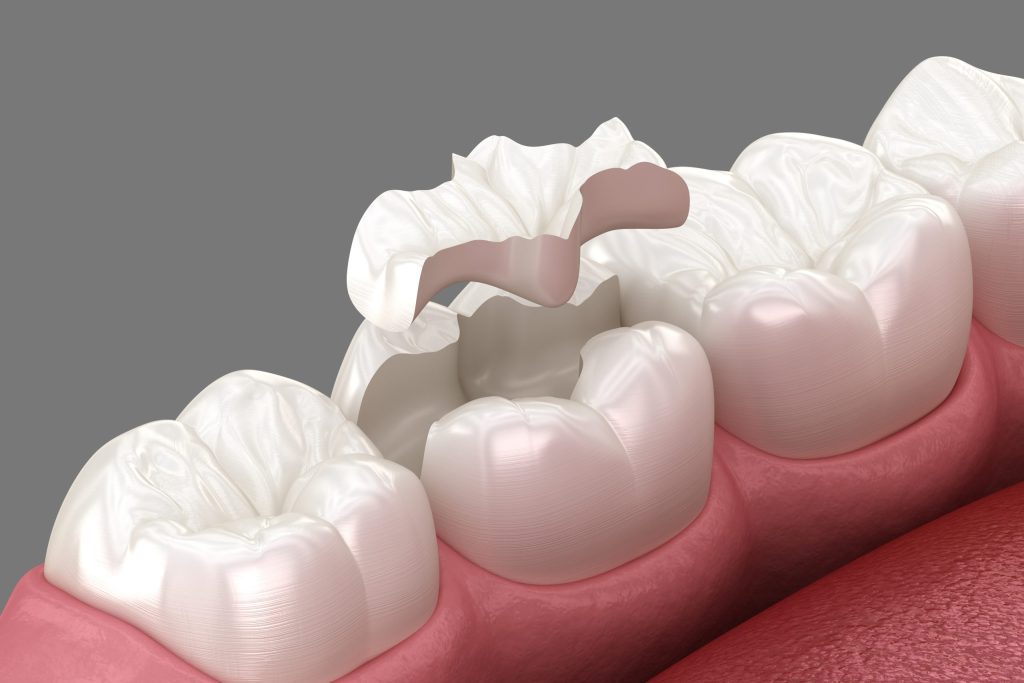
Ans. To avoid pain, local anaesthesia is used, and then the dentist starts the drilling process on the affected tooth enamel to remove the damaged or infected part of your tooth. Later, this area is cleaned and sterilised to avoid infections, and then a suitable material is used to fill the drilled and cleaned area. And finally, a final shape and polishing is performed on the tooth to make it usable like normal teeth.

Q. 3. How Long do composite fillings take to set?

Ans. However, the material used to fill the affected tooth in dental composite is made to set just after being exposed to a medicinal light during the filling process. However, it takes a few hours to make the filled material more strong and long-lasting. Hence, dentists recommend avoiding eating or drinking anything for at least 2 hours after this dental procedure and don’t eat hard or sticky food items for at least for next 24 hours. This kind of precaution helps the filling become strong and reach to its full strength.    

Q. 4. What are Composite Dental Fillings Made of?

Ans. The composite dental filling is mainly made of resin-based matrix materials and inorganic fillers, in which the resin matrix is naturally a type of plastic. And the resin materials include substances like bisphenol A-glycidyl methacrylate (BISGMA) and urethane dimethacrylate (UDMA). 

This kind of filler is a ground glass-like particle, such as silica, that provides strength to the teeth. Apart from that, some of the other materials that are used in composite filling are polymerisation initiators, coupling agents and stabilisers to make the filling hard and improve bonding between resin and filler to prevent degradation of the material over time.

Q. 5. How Strong are Composite Fillings?

Ans. Composite fillings are strong enough to provide the natural strength to the teeth, mainly for front teeth, as there is less chewing pressure compared to back molars. However, the durability and strength of filling also depend on the type of material used in the filling, like gold or amalgam, that can withstand the strong biting force with the chewing capability of normal food items.

However, other popular and affordable materials like resin and glass filler are also considered strong and durable enough to provide the strength and durability to the teeth. Usually, the average life of composite fillings is from 5 years to 15 years, depending on the type of material, placement and oral care. While composted filling would not be suitable for high-stress areas of people who have teeth grinding health disorder.    

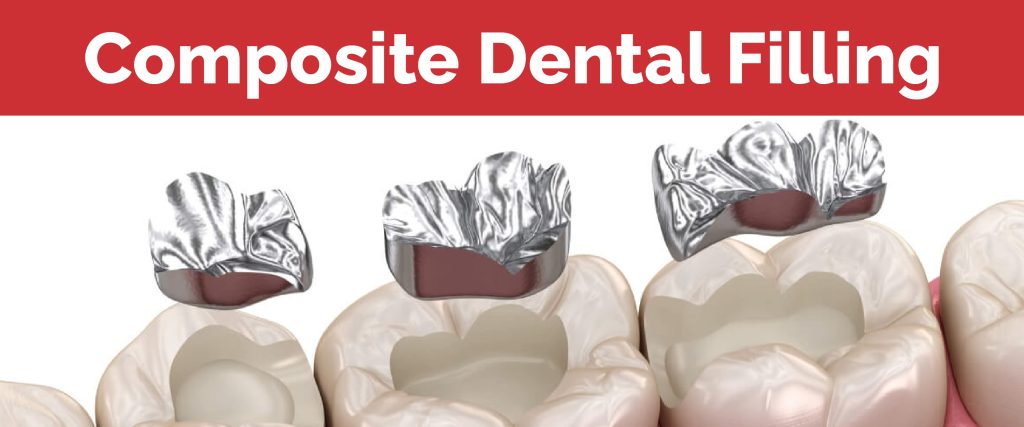
Composite Filling

Q. 6. How long do Composite Fillings Last?

Ans. The longevity of composite filling mainly depends on the type of material, placement and oral care. Usually, the life of most common material resin fillings typically lasts for 5-7 years, with the possibility to stay for more years if maintained with good oral hygiene and preventive care. However, smaller fillings in smaller areas last longer compared to larger fillings in widespread areas like molar teeth.

While eating habits like chewing very hard food items, consuming highly sticky foods, ice cream, and extremely hot or cold drinks also affect the life of the composite fillings. And bad habits like not properly brushing or cleaning and biting your nails can affect the longevity of the composite fillings.   

Q. 7. How Much do Composite Fillings Cost?

Ans. The cost of composite filling also depends on various factors like types of material, complexity of the filling process and knowledge or experience of the dentist. A dentist practising in a highly posh area will charge a higher amount for the same treatment compared to a dentist providing the dental services in a middle-class society. However, in India, composite filling may cost between Rs 1,000 to Rs 5,000 per tooth.     

The amalgam fillings are comparatively less expensive, while gold or other expensive materials used in the filling will increase the cost composite filling dental procedure.  While the ceramic inlays or onlays are one of the most expensive fillings, as they are fabricated in a dental lab and then bonded to the tooth.

Q. 8. Why are Composite Fillings More Expensive?

Ans. The reason behind the high cost of composite fillings is the cost of materials, time spent on the placement, use of advanced medical equipment and specialisation to perform this procedure. A resin-based material used with glass or quartz fillers is costlier than metal alloy, which is basically used in amalgam fillings.

On the other hand, composite fillings give a more aesthetic and natural look to the tooth, but are also expensive compared to silver-colored amalgam fillings. However, the cost of composite filling also differs as per the fees and charges by the dentist, which depends on their location, knowledge and experience.  

Q. 9. Why do Composite Fillings Turn Yellow?

Ans. One of the biggest reasons behind the composite filing turning yellow from consuming food and drinks over time. While the inadequate polish and porous nature of the material could be another cause of the composite filling turning yellow. And smoking or chewing tobacco products also makes filings yellow.    

In fact, composite filling made of material like resin is porous, making it easier for stains to be absorbed, turning the filling yellow. And with time being the natural degradation of composite materials also leads to their discolouration. And lastly, improper care of your teeth also makes the filling yellow. 

Q. 10. How to Maintain or Take Care of Composite Fillings?

Ans. The best way to maintain or take care of your composite filings is always to brush twice daily, keep flossing regularly and avoid eating sticky or hard food items that can harm the fillings. You should also avoid sugary and acidic foods, including ice, hard candies, coffee, tea, and alcohol.  And last but not least, you should regularly visit your nearest tooth filling in Greater Noida to check the condition of your fillings and have your teeth professionally cleaned. The dentist will also recommend the right treatment if there is any critical issue related to your composite filling or another tooth.    

What is a Composite Filling: How it is Done & Take Care of it? 

Composite Filling
What is a Composite Filling: How it is Done & Take Care of it? 

Cavities in the mouth create holes in the teeth not only making your teeth structure weak but also it can erode the enamel of your teeth causing pain and swelling in the mouth. If you don’t take care of such affected teeth, it can cause a major problem and you might need to go to critical dental problems.

To cure critical dental problems you need to go through a critical dental procedure like Root Canal Treatment or in the worst condition you need to remove such tooth permanently. Hence, the best way to cure the cavity at the initial stage is to get the composite filling to prevent your teeth from further decay and cavities. Let’s find out about the composite filling, how it is done and cure your teeth.

Also Read: How to Protect Teeth from Cavity Growing and Getting Worse

What is a Composite Tooth Filling?

A composite dental filling is a dental procedure in which a dentist or dentistry medical professional uses different types of material to fill the hole in the tooth to make it strong and healthy. The material used in composite filling is called resin material and can be the best alternative to traditional amalgam fillings.

The material used for filling is like a natural tooth colour that becomes invisible after filling and provides strength and protection to the tooth. This composite filling material is made of silica, and there could be other types of materials used in the composite filling depending on your tooth condition and affordability.   

How Composite Fillings Are Done?

The dentist starts with a diagnosis procedure and based on the tooth conditions the treatment is performed. To avoid pain, the dentist will use local anesthesia to numb the tooth and surrounding area, and then start the drilling process in your tooth enamel to remove the infected or damaged part of your tooth.

Afterwards, this area is cleaned and sterilized to avoid infection, but before filling any material into it, the dentist etches and bonds the tooth. Lastly, the right composite material is filled into the hollow area with multiple layers applied to ensure the entire gaps and every corner is properly filled.

Before giving the final shape or contour and polishing of the tooth, the dentist makes sure your tooth becomes solid enough to tolerate the bite pressures and you are comfortable with the filling or not facing any major problem in your jaws or opening or closing your mouth.

composite filling

When You Required Composite Tooth Filling?

The time when your tooth becomes hollow and damaged due to a cavity you need to fill this hollow space with a special type of material that is known as composite filling. However, there could be various other reasons the dentist can recommend you to go through the dental procedure of composite filling.  

Reasons Why You Need Composite Fillings:

  • Broken Teeth
  • Cracked Teeth
  • Chipped Teeth
  • Decayed Teeth
  • Hollow Teeth
  • Worn Teeth
  • Space Between Teeth

Types of Composite Filling Materials

Dentists can use different types of composite filling materials as per the teeth conditions and affordability of the patient. The most common materials used in the composite filling are porcelain, Glass and quartz. Many people prefer to get gold, a silver amalgam that consists of mercury mixed with silver, tin, zinc, and copper or plastic made and tooth-coloured composite filling for the teeth. 

Moreover, there is another strong material called glass ionomer that is used in the same way for composite resin filling. However, based on your tooth position and extent of the decay and the cost of filling materials, you can choose the right one suggested by the nearest dentist in Greater Noida.

How Long do Composite Resin Fillings Last?

This could be one of the biggest concerns of the patients looking to get the composite filling in their teeth. The longevity of the composite filling depends on your daily lifestyle, eating habits, oral care or dental hygiene. However, the types and quality of materials used in composite filling also play an important role in the durability and longevity of the composite filling which you can check below. 

  • Composite Fillings last 5 to 15 years
  • Gold Fillings last 15 to 20 years
  • Amalgam Fillings last 5 to 25 years

How to Take Care of Composite Fillings?

The durability and longevity of the composite filling not only depend on the types or quality of material used in this dental procedure. But the way you take care of your teeth also plays an important role in how long composite filling lasts. Hence, you need to take care of your teeth and follow a few instructions after composite fillings to get maximum performance of the composite filling with the best results.     

composite filling

After composite filling, you should avoid eating hard food materials that need extra pressure to chew. Apart from that, also avoid materials that can easily stick in such gaps like gutkha or tobacco materials that can disturb the composite filling. Also, take care while brushing and avoid consuming excessive hot and cold beverages or you can also use the mouth guards to protect your teeth.        

Visit the Dentist for Regular Checkups 

Last but not least, if you have gone through any type of dental procedure in your lifetime you should keep visiting your nearest dental clinic for tooth filling in Greater Noida. As with the time being such composite filling can tear down or can be exposed due to regular eating habits.

Here, when you visit your nearest dentist near Purvanchal Royal City, Greater Noida, the dentist will examine the latest condition of the composite filling and if there is any further treatment or dental procedure required it will be performed to ensure the long-lasting performance of the composite filling.   However, for long-lasting performance of composite filling, you can visit the Dr. Sinha Dental Clinic in Greater Noida, where you can get best-in-class treatment for various types of dental problems. And for the long-lasting composite filling, Dr. Sinha Dental Clinic could be the best option to get the low-cost tooth filling.
What are the Advantages & Disadvantages of Dental Implants?

dental-implant
What are the Advantages & Disadvantages of Dental Implants?

Dental implants are one of the critical but effective dental procedures to install new teeth in the place of missing ones. However, dental implants are still one of the most preferred and long-lasting dental procedures to place new teeth with a strong base and natural chewing capability.

There are multiple reasons dental implants can be one of the best dental procedures but they also have some drawbacks that make them not preferred by few people. If you extracted any of your teeth or looking to get a new tooth through dental implants, you need to understand its pros and cons. Before we let’s talk about its definition and how it is done to understand it better.

What are Dental Implants?

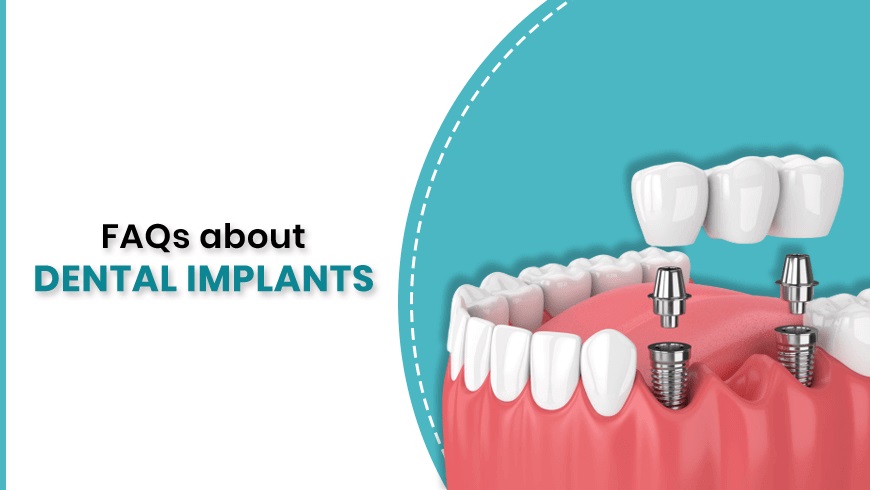
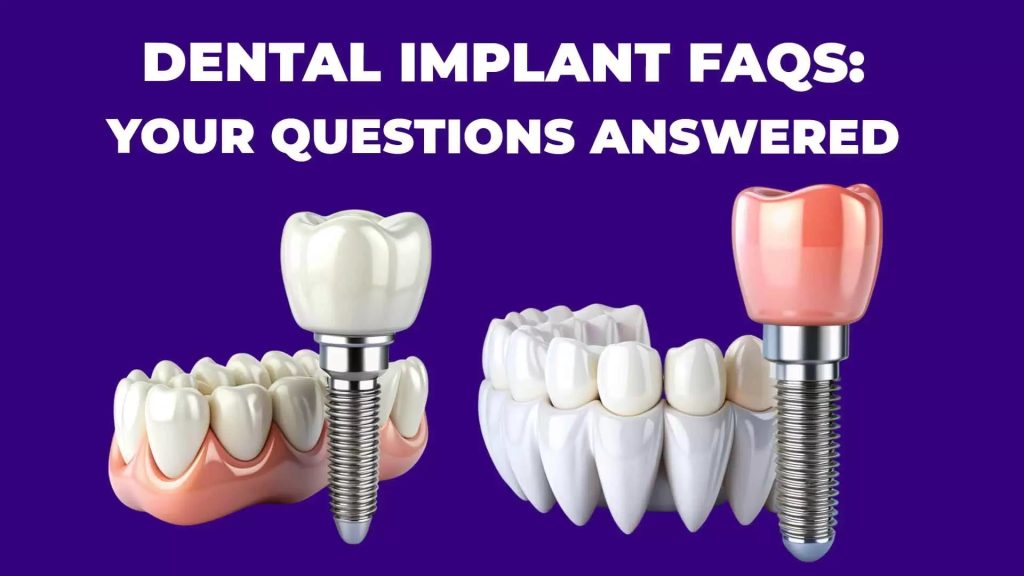
Dental implants are the dental procedures used to implant the new teeth using the ceramic or titanium posts underneath the jawbone to support the artificial tooth. To make the base strong and long-lasting a metal screw is inserted that can hold the new tooth with full support and chewing capability.

How Dental Implants are done?

The dentist examines the affected area and while performing this dental procedure a complete diagnosis is done to make sure there is no infection and enough space is available to implant the new tooth. When the dentist found everything ok, a minor cut was done to expose the root area. This area is also drilled to create a hole where the metal screw can be implanted to support the new tooth.

Also Read: What is Dental Implantology & How are Dental Implants Done?

Further, during this procedure, an abutment is attached to the drilled area using an abutment fixation screw that is extended through the gums to the mouth to support the new teeth that will implant here. The entire procedure is done carefully while ensuring the safety and precautions of the patients. Before you opt for this service let’s find out its advantages and disadvantages.

dental implants advantages and disadvantages

Dental Implants Advantages and Disadvantages

Dental Implants Benefits:

A dental implant helps to get the new teeth with a natural look and strong biting experience. Let’s find out what are the other benefits of dental implants.  

Also Read: Why Dental Implants Are Important and its Benefits?

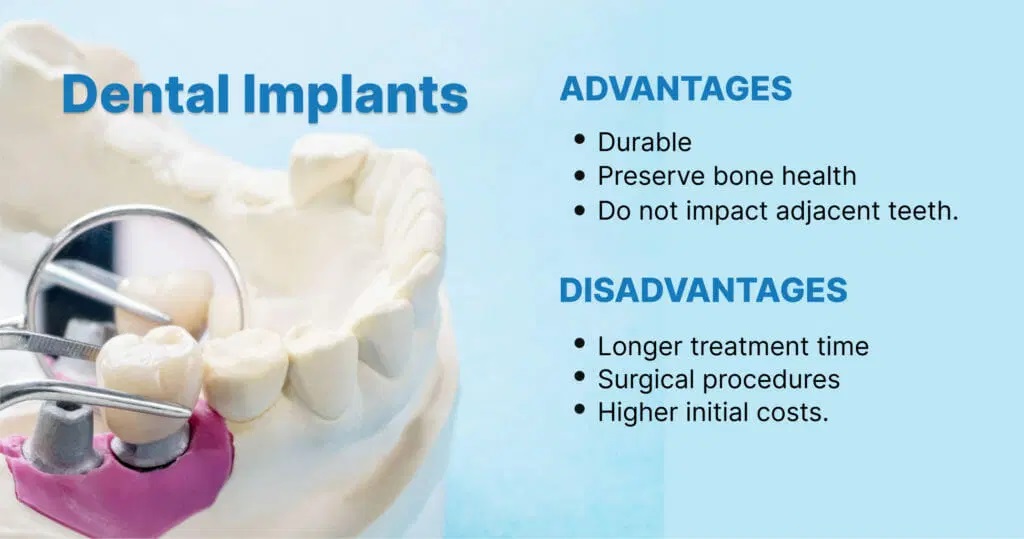
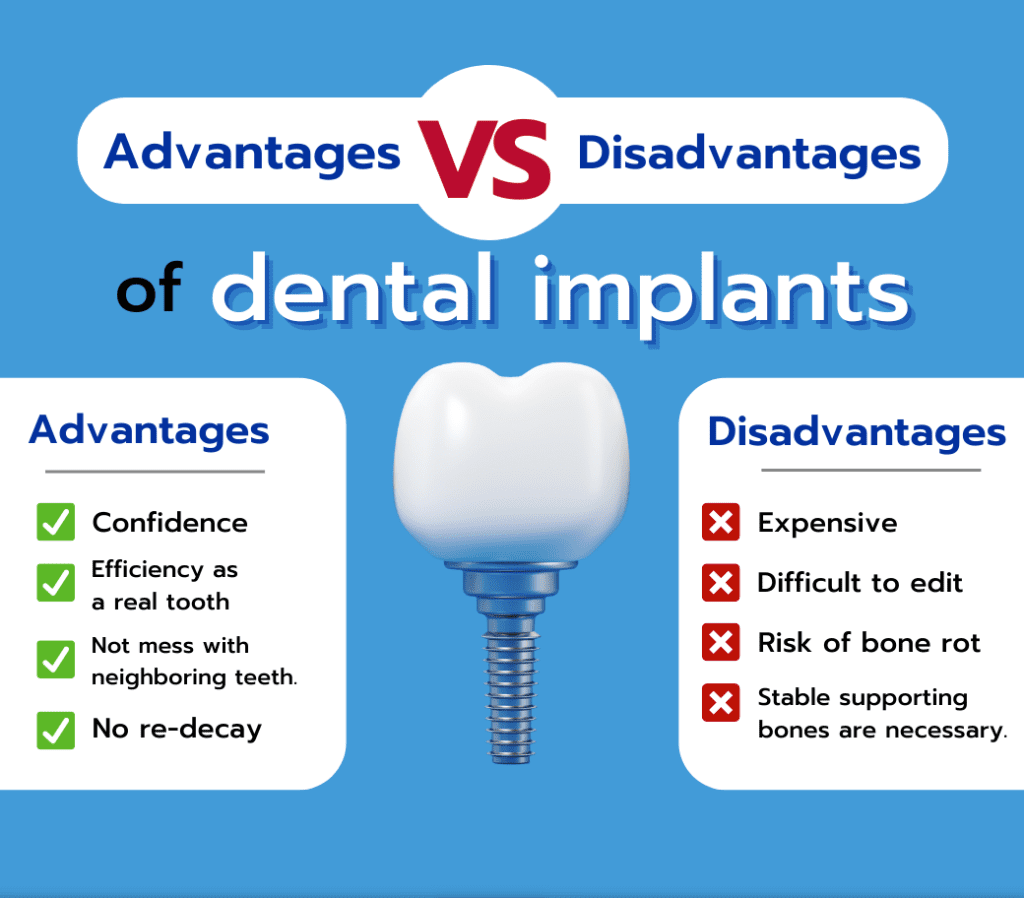
Strong Base: Owing to the use of metal screws to create a strong base for implanting the new tooth, the base of the tooth in the dental implant becomes very strong. This kind of strong base provides a strong base for an artificial tooth that offers a resilient and even strong bite force for the users.

Highly Durable: As per the dental association, the tooth installed through dental procedures is not only long-lasting but highly durable. If implanted professionally using the right dental procedure it can last for many years with the same level of durability without affecting its performance. 

Appearance: The tooth and crown used in the dental implants are made of such natural look-like material. This kind of natural implanting makes your tooth look like an original tooth giving you a better reason to simile. Overall, it helps to improve your mouth and dental structure appearance.    

Comfortable: There are few dental procedures after going through you can get new teeth but many of them are not so comfortable for the end-users. In fact, the gum’s shape keeps changing as per the changes in your dental and mouth structure. And if you go through a dental procedure, it might be affected and can cause discomfort. But dental implant provides a comfortable dental treatment to everyone. 

Prevents Bone Loss: When you extract or lose your teeth, they should be replaced with new teeth, otherwise your jawbone can be disturbing and can change your face and mouth. But a new tooth is implanted through dental implants it stabilizes your jawbone and helps to prevent bone loss.

Ease of Talking:  Without having the proper number of teeth or with denture-like teeth structure you can face while speaking or smiling, especially in public places or in front of others. But with dental implanted teeth you can speak or smile without teeth slipping or facing any problem in your jawline. 

Better Chewing Experience:  One of the best advantages or necessary features of having a new tooth through dental implants is you will have a better chewing experience. You can face with dentures or install a new tooth with any other dental procedure.  

dental implants advantages and disadvantages

Drawbacks of Dental Implants:

Though, dental implants can provide you with the new tooth with the best various other benefits. However, there are some disadvantages of dental implants, let’s find out the same here below.

A Surgical Procedure: Dental implants are performed through a surgical procedure, which is not only a time taking but also a complicated and perilous treatment process. And when you go through surgery you need to take lots of precautions before and after surgery to recover successfully.  

Chances of Infection: As it’s a surgical process, there is a huge risk of infections and inflammation around the treated area. And if infection is not cured timely or properly, it can cause the major oral problem in your mouth like cancer or other serious medical problems in your mouth or gums.  

Failure of Implants: As we said, implants are a complicated surgical process, hence there are also the chances of implant failure, especially if not performed carefully or not by an experienced professional implant dentist in Greater Noida. The failure of implants can cost you in terms of prolong treatment process and, the high cost involved in covering the treatment procedure with more pain and discomfort.

Time-Taking Procedure: As we already said, implants are the time taking and long treatment procedure, because you need to visit multiple times at your nearest dentist in Greater Noida to get this treatment. You need to make multiple appointments to get a diagnosis and complete the entire treatment procedure.   

High Cost of Treatment: Compare to other dental procedures, the cost of dental implant treatment is much higher. Not every person can afford the cost of dental implants. However, the cost of treatment may vary depending on the location of the clinic, dentist charges and the types of dental implants. 

Summing-up

Dental implants no doubt are one of the most complicated but reliable, effective and long-lasting dental procedures. Though, the cost of treatment is high and the risk of infection or implant failures too. But, if you visit at best dental clinic in Greater Noida you can get the best treatment performed by the experienced dentist Dr. Sinha who is specialist to provide the dental implants treatment at a reasonable cost. 

Top 10 Frequently Asked Questions about Dental Implants

faqs about dental implants
Top 10 Frequently Asked Questions about Dental Implants

Dental implants are one of the most popular dental procedures dentists use to replace a missing tooth. Implants are also one of the complicated but long-lasting dental procedures used to install the new tooth with a strong base and trouble-free chewing experience.    

Also Read: Top 10 Frequently Asked Questions About Root Canal Treatment

However, the dentist recommends this dental procedure as per the tooth condition and applicability. But many people are not aware of this dental procedure and don’t know which dental procedure is suitable for them. If you are one of them looking to get dental implants, you need to know about this. Below you can find the top FAQS about dental implants with their answers. 

Q. 1. What is Dental Implants?

Ans. Dental implantsare a type of dental procedure to place a new tooth in the place of a missing tooth. An artificial tooth is installed by screwing with the metal base to create a strong foundation. The metal screw is inserted into the jawbone that works like an anchor to support the artificial teeth. Tooth installed through implants are long-lasting and provide a natural chewing experience. 

Q.2. How are dental implants done or installed?

Ans. Dental implants are performed on the place of the missing teeth to install the new ones. A dentist starts with cutting the gums to fully expose the gums and drill the hole in the bone where it can implant a metal screw that is attached with an artificial tooth. The screwed metal works like supporting base to the implanted tooth to keep it strong and functional for long lasting days.  

After implanting the tooth, the dentist can cover this tooth with a crown to provide an extra layer of protection to your teeth with a natural look and feel. And if the patient is facing any kind of problem after this dental procedure, it can be restored with the right treatment procedure to ensure the implant’s functionality.   

faqs about dental implants

Q. 3. What is the Procedure for Dental Implants?

Ans. To procedure of dental implant mainly depends on the dentist’s treatment process in medical practice. However, there are several stages every dentist follows to complete this dental procedure. In a traditional method of dental implants, the cutting of gums and then drilling is used to create the space and base for implanting the new teeth, which is followed by every dentist. 

Later one the tooth is implanted attached with the suitable material like titanium to place the teeth with the help of the screw. And after that, the capping process is done to keep the newly implanted teeth safe, which is later removed and covered with a crown to provide the natural look and feel with strong chewing and biting experience and ensure its long-lasting performance.    

Q. 4. What are Dental Implants Made of?

Ans. The substances used in dental implants are mainly made of such durable and long-lasting materials that they can support the teeth without getting damaged in the natural living environment of the mouth or while chewing food. Most of the dental implants are made of titanium or zirconium oxide.

However, some other metals like gold alloys, titanium alloys, stainless steel, cobalt-based alloys, polymersand ceramic-based materials are also used for dental implants. And as per the dentists, titanium is considered one of the best materials for implants, providing a strong base with the ability to absorb the robust biting and chewing pressure without disturbing the implanted tooth.   

Q. 5. How painful are Dental Implants?

Ans. Dental Implants are a surgical process that involves cutting of the gums and installation of a metal-grade material. The patient going through this dental process has to bear some pain and discomfort. In fact, dentists use the medication process to numb your gums so that you can experience the least pain during the surgical process. But after surgery due to swelling and wounds, you will feel some pain.  

Here again, the dentist will recommend some medicine to heal the surgical area with painkillers to provide you relief from the intolerable pain. However, the level of pain depends on the surgical process and location of your teeth, as implanting the molar tooth inside the last row is more complicated and painful. And it depends on the patient’s ability to tolerate such pain without taking medicines. 

Q. 6. Why are Dental Implants Important?

Ans. Dental implants are considered one of the best alternative dental procedures to get a new tooth in place of a missing tooth. Without having a tooth, you would not be able to chew food and also feel uncomfortable while opening your mouth in front of others. The most important thing about dental implants is that they help to develop the bone growth around the implant area and strengthen the bone while building support around the teeth.

The teeth installed through dental implants look like the original ones and reduce the submerged view that appears with bone loss in the jaw. And one of the best parts of this dental procedure is, it helps to prevent the bone from natural loss that comes with ageing.  

Q. 7. How Long do Dental Implants take to heal?

Ans. Although the recovery and healing of the affected area performed through dental implants depends on the level of the surgical process and the patient’s body response. The initial healing comes within one week, but it can take from three to six months for your jawbone to completely adapt to the implants in your mouth. 

In fact, the entire healing process is distributed into different phases. The first healing you will realise within 24 hours of the surgery is that your gums’ swelling and pain will be minimised. Later, the healing of soft tissues is visible within one to two weeks. And finally, the bone healing process can take from three months to six months, which is also known as the adjustment phase of new implants.      

Q. 8. How long do Dental Implants Last?

Ans. As per the dental association, dental implants is like is a permanent solution and one of the best dental procedures that last longer than other dental procedures. The dental implant has an interface directly with the jawbone that becomes bonded with surrounding bone tissue through a process known as osseointegration.

faqs about dental implants

And when the osseointegration process ends, the material used in implants and the surrounding bone merge with it, forming a solid foundation for a prosthetic tooth. The implants are designed to be permanent, but the cap or crown attached to them needs to be replaced after 15 to 20 years. 

Q. 9. What is the Average cost of Dental Implants?

Ans. The cost of the dental implants procedure mainly depends on the type of implants, the dentist’s location, course of treatment and the affordability of the patients. In India, the cost of every single dental implant may cost you from Rs 15,000 to Rs 50,000 and go up to Rs 4,0,0000 for the entire mouth.

The cost of implants varies depending on the type of material used in implants; the ceramic or cement-based crown is cheaper than a Zirconia Crown. While the gold material used in the implants is the costliest one. However, the average cost of implants is around Rs 25,000 to Rs 35,000.   

Q. 10. Why are Implants so Expensive?

Ans. The dentalimplantprocedureis not only time-consuming but also a critical one that requires extra knowledge and experience to perform successfully. There are various stages to complete the dental implants, like extracting the damaged or infected non-functioning tooth (If any), then creating a space for implants. After that, implanting a tooth with extra care and safety, and finally, the crown.

Apart from that, the type of material like titanium, used in the dental implant is also responsible for the high cost of dental implant treatment. And the long-lasting performance of this dental procedure also makes this expensive, especially if you have visited a highly skilled or experienced dentist in your area. However, you can get low-cost dental implant services in Greater Noida at Dr. Sinha Dental Clinic.

How to Cure Sensitive Teeth & Treatment for Sensitive Tooth

cure sensitive teeth
How to Cure Sensitive Teeth & Treatment for Sensitive Tooth

Sensitivity in teeth is one of the most common problems among people of all age groups across the world. When you go through this tooth sensitivity problem, every time when you consume hot or cold liquids or food items you will feel a kind of sensation in your affected teeth. 

However, with the time being of age, you can sense some amount of sensitivity, especially at the time of eating either extremely hot or child liquids. But if you start facing this dental problem at a young age or have high sensitivity even when consuming temperature food and beverages, then the situation is getting worse and you need to cure this with the right treatment.    

Main Causes for Sensitive Teeth

When your teeth are healthy or don’t have any dental problems like tooth sensitivity or cavities, the underlying layer of dentin is covered by enamel and the roots of the tooth are protected by gums. But when the gum line started receded, then enamel starts getting damaged exposing the teeth dentin.

Also Read: How to Protect Teeth from Cavity Growing and Getting Worse

However, the dentin can be exposed due to multiple reasons like cracked teeth, cavities, cavities, root erosion or enamel erosion. This Dentin is well-connected with the nerves of your body that realize sensitivity and pain in your teeth when your dentin is exposed. 

Also Read: What are the Causes of Sensitive Teeth? Reasons for Sensitivity

Dentin is made with thousands of microscopic tubules, or channels that cause tooth pulp and when it is exposed then these dentinal tubules are not able to stop heat, cold, acidic or even sticky substances from reaching the nerves inside the tooth. And when such substances touch the nerves you feel a strong sensation in your teeth and gums that is called sensitivity.  

How to Treat Tooth Sensitivity at Home?

When you start realizing such pain or sensitivity in your teeth you can apply some home remedies for tooth sensitivity to get relief from such dental problems. Though, there are various home remedies for teeth sensitivity that you can try at your home but are going to share here the best and highly effective treatment that will help you get rid of the tooth sensitivity.   

Fluoride Can Give Instant Relief

Using fluoride in your mouth toothpaste or mouthwash is one of the best ways to cure tooth sensitivity at home. The fluoride contained in the mouthwash or toothpaste helps to strengthen the enamel of teeth and also reduces tooth sensitivity and pain from sensitive teeth.  

You can use fluoride-based toothpaste or mouthwash on a regular basis or can also directly apply the fluoride gel on the sensitive tooth area. To get permanent relief from sensitivity you need to regularly use fluoride-based mouthwash or toothpaste. You can find medicated toothpaste that are fluoride-based or especially made to provide relief from sensitivity problem.        

Desensitizing Toothpaste or Bonding

Desensitizing toothpaste is another useful home remedy you can use to cure the teeth sensitivity problem. The desensitizing toothpaste or bonding helps block nerve signals in the dentin which helps to reduce the pain caused by the sensitivity. In fact, regular use of such compound gradually builds up a type of protective layer on your sensitive teeth, reducing the sensitivity over time. 

Desensitizing toothpaste contains an active ingredient called potassium nitrate that can block the pain signals you realize through a nerve in your tooth that travels to your brain. Similarly using the bonding by applying to the sensitive exposed root surface will provide you relief from such pain.

Other Home Remedies for Tooth Sensitivity  

Apart from both these most effective and practical home remedies for tooth sensitivity, you can also try various other therapies like using clove oil, salt water rinse, oil pulling, vanilla extract, turmeric, guava leaves, peppermint, hydrogen peroxide and garlic.   

However, these remedies are effective when you have normal sensitivity or when you apply these therapies at the initial stage of sensitivity in your tooth. If your tooth sensitivity problem is getting worse or become severe, then you need to visit your nearest dentist in Greater Noida. Here you get the medicated treatment to cure the tooth sensitivity problem.  

cure sensitive teeth

Best Dental Treatment for Tooth Sensitivity

Again when some of the home remedies do not work in severe conditions, you need and medicated treatment by the dentist to cure the teeth sensitivity problem. For that, you have to visit at nearest dental clinic in Greater Noida, where the dentist will diagnose the actual dental problem causing the teeth sensitivity and its condition to recommend you best treatment.

Surgical Gum Graft

If your tooth showing sensitivity has lost gum tissue and its roots are exposed, then the surgical gum graft technique can be used to cure the sensitive teeth. In this critical dental procedure, the dentist will take a small amount of tissue from somewhere else in the mouth and fix it to the affected area.

Also Read: Types of Dental Procedures Used for Treatment of Teeth Diseases

The tissues taken from deceased donor tissue to attach to the affected site protect exposed roots and reduce sensitivity. In this surgical dental process, the surgeon repositions your gum tissue and stitches it into place which not only takes time but also requires more expertise to perform this process with complete safety and precautions. Here you need to visit the best dentist near Kendriya Vihar, Greater Noida to get the right treatment at very reasonable charges.

Root Canal Treatment (RCT)

This is one of the most critical and extravagant dental treatments you can take when you don’t want to lose your original tooth and enjoy a pain-free chewing experience. The root canal treatment will cut your connection from your affected tooth’s nerves and fill it with suitable materials after cleaning the infected pulp helping the patients to enjoy the painless chewing experience.

Also Read: Top 10 Frequently Asked Questions About Root Canal Treatment

RCT Though, this is also a critical as well as time-consuming and expensive dental treatment but can restore your original teeth with new-like strength. And it will completely provide you relief from tooth sensitivity while giving the biting and chewing experience with proper capping of teeth. Again to get the RCT you need to visit Dr. Sinha Dental Clinic, where Dr. Sinha will diagnose and provide you with the best treatment for tooth sensitivity as per your ease and availability. 

Top 10 Frequently Asked Questions About Root Canal Treatment

faqs on root canal treatment
Top 10 Frequently Asked Questions About Root Canal Treatment

Root canal treatment (RCT) is one of the most critical treatment procedures in dentistry that creates lots of questions among the patients when they go through or are recommended to get this treatment. However, this dental procedure is not only critical but also painful, time and expensive.      

Similarly, many questions arise when you listen to RCT and you might be also curious to get the right answers about the questions related to RCT. Hence, to clear the myths and get the right answer about RCT we have brought here the top ten frequently asked questions about root canal treatment.

Top 10 FAQs Regarding Root Canal Treatment:

Q. 1. What is Root Canal Treatment?

Ans. Root Canal Treatment (RCT) which is also called endodontic therapy in dentistry is a kind of dental procedure used to treat the infections in tooth pulp, from the innermost layer of your teeth. RCT is considered to save your teeth that are badly damaged due to cavity or tooth decay and nerve infection.

Also Read: How to Protect Teeth from Cavity Growing and Getting Worse

The RCT helps to save such critical teeth by cleaning all the infectious pulp and filling it with suitable material to revive its condition to make it usable for normal chewing. The RCT can be performed for any teeth including frontlines and molars depending on its health condition. The entire procedure is time-consuming and complicated needs multiple visits at the dentist to complete the process.    

Q. 2. How Root Canal Treatment is Done?

Ans. The RCT is done with the long treatment in which various stage of dental procedure is performed step by step in many days. The dentist first diagnoses the condition of the tooth and while performing the RCT can use anesthesia to minimise the feeling of pain. Afterwards, the pulp is removed and an infected portion is cleaned and sterilized using solutions like sodium hypochlorite or chlorhexidine to eliminate any remaining bacteria. 

In the next visits, the affected area is again cleaned and filled with biocompatible material, like gutta-percha to prevent the teeth from cavities or infection. Lastly, the permanent filling may be placed to seal the access opening or the dentist might use the crown to protect teeth and provide extra protection from normal wear and tear. Your RCT is completed with new teeth restored to the original look.     

Q. 3. Why Root Canal Treatment is Required or Important?

Ans. RCT is performed to save your teeth that are badly damaged because of prolonged cavities and tooth decay. When RCT is performed the infected pulp or soft tissue inside care is removed to prevent the gums from swelling and protect other nearby teeth from further infections. People having teeth affected with deep decay, trauma, or cracked and become hollo due to cavity require RCT.  

Also Read: How to Get Rid of Tooth Decay: Natural Ways Remove Cavities

Other important reasons behind performing the RCT treatment are preventing teeth structure from speeding the infection, providing relief from pain and sensitivity and maintaining the oral health of the people. This dental procedure helps to preserve your natural teeth while restoring their functionality and aesthetics. In some cases, RCT is cost-effective compared to other dental procedures. 

Also Read: What are the Causes of Sensitive Teeth? Reasons for Sensitivity

Q. 4. How Painful is Root Canal Treatment?

Ans. When your teeth are infected with bacteria and infection, you already realise lots of pain and discomfort. Curing this dental problem is very important to prevent infection from further spread and save your teeth. However, going through the RCT treatment is also a painful procedure. However, the dentist gives anaesthesia to minimize the impact of pain and discomfort during the RCT.  

During the procedure when the dentist removes and cleans the pulp and infection, you might feel the pain, but anaesthesia will not be able to realise the least pain. However, after this pulp and infection removal when you go back to your home, you might feel the pain, but the dentist will give you medicines to relieve from pain and cure the injury that happened during the surgical process. After the final restoration of teeth, your pain will be normalised and you will not feel any pain and discomfort because of RCT.   

Q. 5. Why Root Canal Treatment is Painful?

Ans. The main cause of infection before RCT is the infection or inflammation in the pulp causing severe pain, sensitivity, and swelling. While during the RCT a necessary surgical procedure is performed that can cause the pain. Dentists use certain tools and apparatus to remove the infection and pulp that cause some pain and discomfort during the RCT procedure. However, the pain impact can be minimized with anaesthesia.

On the other hand, after RCT the pain could be because of multiple reasons like any infection remaining under the teeth. If your tooth nerve got damaged or fractured could be other reasons behind the pain post-RCT. The hard biting or improper alignment and swelling of teeth putting extraordinary pressure on teeth also cause pain and discomfort after RCT. 

 Q. 6. How Long Does Root Canal Treatment Take?

Ans. Performing the root canal treatment is a critical as well as time time-consuming process. However, depending upon the type of tooth, tooth condition, severity of the infection, availability of the patient and capability of the dentist it can take from a few days to many days to complete the entire treatment procedure. Unexpected complications or further restoration of teeth like crowns can take this procedure few more days.

Unusually, one day is required to diagnose your teeth condition, in the next visits you will get your infected teeth cleaned and sterilized and further visits for the filling and in the final round you can get the crown and final touch to your restored teeth with the RCT. If there is no infection or pain after RCT you don’t need to visit anymore, while in case of complications, you have to visit the best dentist in Greater Noida.     

Q. 7. How Long Does Root Canal Treatment Last?

Ans. The longevity of teeth cured through root canal treatment depends on individual factors like the type of material used in the RCT procedure, the presence of complications and care or precautions taken by the patient. Usually, the teeth can last up to 10 to 15 years or even a lifetime if proper care is taken.   

The factors that affect the lifespan of RCT are proper aftercare like regular brushing, flossing and dental check-ups. The restoration work like placing the crown and filling are other factors that affect the life of RCT. Moreover, the location of the teeth, age and health condition of the patient or severities of the infection are other important factors ensure the longevity of the RCT-cured teeth.  

Q. 8. What are the Side Effects of Root Canal Treatment?

Ans. On one side, root canal treatment is useful to get a highly effective and safe dental procedure to save your teeth. But other side it also has some side effects that make this dental procedure less popular among people. Temporary discomfort, swelling, minor infection and sensitivity are the common side effects of the RCT that anyone can realise after going through this treatment procedure.  

Also Read: Types of Dental Procedures Used for Treatment of Teeth Diseases

Q. 9. What is the Cost of Root Canal Treatment?

Ans. The cost of root canal treatment depends on various factors like the location of the dental clinic, dentist consultation fees and treatment charges and affordability to pay the cost by the patients. However, in India, the general cost of root canal treatment can range from Rs 2,000 to Rs 10,000 per tooth. In rural areas, the cost of RCT is cheaper than in urban areas of metropolitan cities.

The costs of treatment vary not only due to location but the type of RCT performed. A general root canal can cost between Rs 2000 to Rs 5000 for every single tooth. While laser-assisted root canal treatment can cost you from Rs 10,000 to Rs 25,000. Similarly, treating the back teeth or molar teeth is more complicated and can cost you more compared to the front teeth. If you get crowns and bridges on such teeth, the overall cost of RCT can increase more compared to normal treatment procedures.

Q. 10. Why Root Canal Treatment is Expensive?

Ans. Yes, it’s true, the cost of root canal treatment is higher than various other dental procedures. The reason behind the high cost of treatment is because of the level of complexities, expertise and technology involved while performing this dental procedure. In fact, to perform the RCT an extra level of precision is required with extraordinary care and precautions to ensure the safety.    

Apart from multiple visits, the type of material used in RCT, the technology used for diagnosis and medical examination and treatment procedure, the retreatment is the other prime factor that can increase the cost of RCT making it one of the most expensive dental procedure in the dentistry. To avoid such high cost treatment you can visit at your nearest dentist in Greater Noida for low-cost RCT with best results.

Why Dental Implants Are Important and its Benefits?

why dental implants are important
Why Dental Implants Are Important and its Benefits?

Without having tooth you could face the problem in chewing food, as there is gap between the two tooth and your gums can’t handle the biting situation. But if you get an artificial tooth through the right dental procedure you can enjoy the painless chewing experience. 

An artificial tooth can be installed through various dental procedures depending on the patient’s mouth condition, compatibility to perform the dental procedure and the ease and affordability of the patient. Dental Implant is one the most popular dental procedures you can opt for. Let’s find out why it is important, its benefits and the life of dental implants. 

What is Dental Implant Surgery?

It is a dental procedure in which a dentist installs an artificial tooth by creating a strong foundation using a metal-made post. When there are no teeth after extracting the existing one, the implant procedure is performed to fix a new tooth that looks natural and also gives a real-life biting experience.

How Dental Implants Are Done and Work?

In this critical dental procedure, dentists expose the bone by cutting the gums, then drill a hole into a bone where a dental implant metal post is placed. The metal post works like a tooth root, as it is implanted into the deep bone to make its roots strong.

A dental implant works like a natural tooth that is replaced against a denture. In implants, a new tooth made from artificial material is used to attach to your jawbone. With dental implants, you can have a fully developed and healthy jawbone to support the implants. 

Also Read: What is Dental Implantology & How are Dental Implants Done

Why Dental Implants are Important?

Dental implants are one the best alternative solution to get a new tooth or you can say it a proper replacement of missing tooth. Though, this dental procedure can reabsorb the minerals in the jaw near the missing tooth that can result in jaw shrinkage and collapse.

This dental implant surgery helps to generate bone growth around the implant area and also reinforces the bone and builds support around the teeth. Its appearance is like original teeth and also reduces the submerged look that can appear with bone loss in the jaw. And this critical dental procedure helps to prevent bone from natural loss in future that can occur with ageing.

Dental Implants Benefits

Dental Implants Benefits

Highly Durable: The base of the dental implants is made with metal materials that make the tooth last longer with better durability. And with the strong base of metal and robust tooth implant allows you to enjoy a set of natural teeth with better chewing experience without teeth sensitivity problem.   

Also Read: What are the Causes of Sensitive Teeth? Reasons for Sensitivity

Better for Chewing: The tooth implanted through dental implants is anchored with your jaw bone which not only makes it strong but also makes it strong. For the time being, it helps to preserve the jaw bone and significantly reducing the bone resorption, providing you a better chewing experience.  

Prevents Bone Loss: When you lose your tooth, and don’t get any new tooth, then there are chances of bone loss. As your jawbone is no longer strained in that part of your mouth making it, breaking down can reabsorbs some of the bone tissue. But dental implant helps to prevent from such bone loss.    

Natural Look & Feel: The procedure of installing a new tooth through dental implants is such highly professional, that you will get the new teeth that will look natural. When a dentist covers the tooth with an artificial crown, the implant mimic like an original tooth with natural feel and comfort.  

High Rate of Success: As per the global dental practices, the success rate of dental implants is as high as 97% which can last upto to 10 years. And over the past years, with improved and more advanced treatment procedures, the success rates of dental implants are improving.  

Better Jaw & Bone Structure: Without teeth your jawbone structure keeps moving towards the deterioration that can disturb the jawbone height. But dental implant helps to restore your jawbone structure as they reduce the load on the other oral structures and preserve natural tooth tissue reducing the bone resorption and deterioration disturbing your jawbone.     

Is Dental Implants Successful?

Yes, dental implants are successful if performed by a highly experienced dentist with the right dental procedure using the most advanced techniques and apparatus. As per the study in 2021, the success of dental implants is as much as high as 97%, if you count the lifespan for the next 10 years.  

Also Read: Types of Dental Procedures Used for Treatment of Teeth Diseases

However, the success of dental implants depends on the life span you expect. The higher the life span the success rate would be lower, while the fewer years life span can give you the highest rate of success in dental implant surgery giving you one of the best alternatives to get new teeth. 

Life of Dental Implants

As we told you the higher the life span, the success rate would be lower, and the lower the life span the success rate would be high. But if you count an average life of 10 years, then the success rate of dental implants is 96.8% and if you take care of implanted teeth, you can enjoy a life of up to 15 years.

Best Place to Get Dental Implants Near Me?

The best place to get a dental implant is to visit your nearest dental clinic having all the medical facilities and an experienced dentist. If you are living in the Greater Noida area and looking for best dentist in Greater Noida, then you can visit at the Dr. Sinha Dental Clinic.    Here you will get dental implant services at an affordable cost with one of the best dental treatment and care facilities. Dr. Sinha here performs the implant services for all age groups of people to make them get the new teeth without going through a painful and discomfort situation. You can book an online appointment here to consult the dentist or directly visit here as per your wish.