
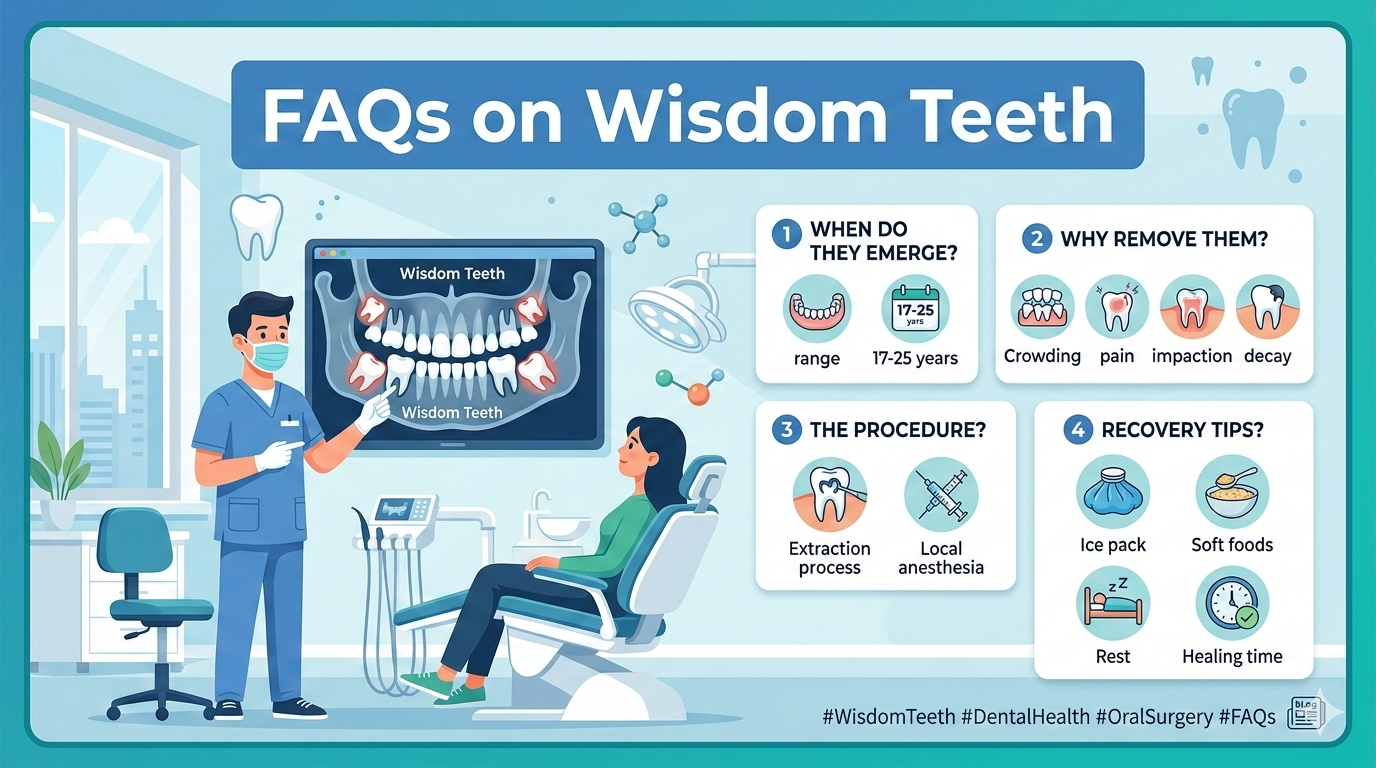
Wisdom teeth are an additional set of teeth that grow as third molars, usually when you attain the age of maturity. When it grows, it can be very painful and sometimes becomes intolerable or feels awkward when impacted or erupts between the existing molars, creating overcrowding.
It should be removed or not; similarly, there are unlimited questions that come to mind about the wisdom teeth. So right here we brought the top ten frequently asked questions on wisdom teeth with their suitable answers. Let’s read out the answers to the FAQs on wisdom teeth.
Q. 1. Why are Wisdom Teeth Called So?
Ans. The term “Wisdom Tooth” is derived from the Latin dens sapientiae, meaning “tooth of wisdom”. However, in other cultures, they are also known as “teeth of judgment” (In Spanish: las muelas del juicio) or “far-standing teeth” (In Dutch: verstandskiezen).
Wisdom teeth usually come after adolescence, when you attain or enter the age of adulthood. Traditionally, it is considered when you reach the age of maturity and gain the wisdom to understand life with much wiser experience compared to childhood or adolescence.
Q. 2. At What Age do Wisdom Teeth Come In
Ans. Wisdom teeth usually grow between the ages of 17 and 25 years, or you can say they erupt in late teens to early twenties. The most active age of wisdom teeth growth is 18–24 years old. Though they break through in the late teens/early twenties, roots can continue developing for up to three years after eruption.
However, few people can have wisdom teeth beyond the age of 25 years in their 30s. And if it happens, it is generally considered that they will not erupt on their own.
Q. 3. Why do Wisdom Teeth Grow and Come So Late?
Ans. The wisdom teeth, which are also known as third molars, usually erupt between the ages of 17 and 25 years because only after this age has the jawbone fully matured and developed enough to provide space for such molar teeth. However, a smaller jaw size can cause wisdom teeth to grow impacted or crowded.
The main reason behind late wisdom teeth growth is that you need a fully grown jawbone for structural support. However, the hormonal changes during the teenage years can stimulate the movement of these teeth toward the gum line. And due to smaller jaws, there is limited room for the last set of molars, often causing them to grow either impacted or at awkward angles in the jaw.
Q. 4. What Are the Symptoms of Wisdom Teeth?
Ans. One of the initial symptoms of wisdom teeth growth is pain and swelling with sensitivity in the back of the mouth or around the last molars. However, the other indications of wisdom teeth eruption are bad breath, jaw pain, and unpleasant taste in the mouth.
Apart from this, you might also face problems opening in your mouth or notice the physical changes in your face, like facial swelling or swollen lymph nodes under the jaw. And you can feel some kind of awkward pressure or movement in the surroundings.
Q. 5. Why Wisdom Tooth is Painful?
Ans. An impacted wisdom tooth that grows impacted or stuck between the existing molar teeth can cause gum inflammation, infection and extreme pain. A partial eruption can create flaps of gum tissue that trap food and bacteria, leading to pain, swelling, and decay in teeth.
The wisdom teeth push against the second molars, which mainly cause pain, and due to overcrowding, they can cause potential damage to existing teeth. Another reason for pain during wisdom teeth growth could be the grinding of teeth, where the tooth is trying to emerge.
Q. 6. How to Stop Wisdom Tooth Pain?
Ans. To get relief from wisdom teeth pain, you can perform home remedies like putting clove oil, using salt water rinses or applying cold compresses on the cheek. However, you can also chew the onion pieces or apply the numbing gel to reduce the pain.
And if you do not get any relief from such remedies, you can take the painkillers like Ibuprofen or other OTC anti-inflammatory medication under the supervision of a doctor. To feel less pain, you also need to avoid hard foods and consume soft foods while maintaining your oral hygiene.
Q. 7. Why Does a Wisdom Tooth Need to be Removed?
Ans. Usually, most of the wisdom teeth are impacted or grow in an overcrowded space around the molar set of teeth. If you don’t remove the wisdom tooth, it can not only cause pain but also damage to adjacent molars, gum disease, and the formation of cysts or tumours.
Wisdom tooth extraction is important to prevent other teeth from being affected by the space consumed by this unwanted wisdom tooth. Apart from overcrowding, it can cause infections like pericoronitis, tooth decay and gum disease, and it can badly damage the other nearby teeth and molars.
Q. 8. What to Eat After Wisdom Tooth Extraction?
Ans. After wisdom tooth removal, you need to take precautions for a few days to heal the wounds caused by the surgery on the tooth. In the first 24–48 hours after tooth extraction, you need to stick to a soft-food and liquid diet that will help you to protect the extracted area from the dislodging of blood clots.
However, after these crucial hours, you can enjoy blended soups & broths or consume yoghurt & pudding, ice cream and applesauce & pureed fruit.And for vitamin intake, you can consume smoothies, but don’t use the straw to avoid direct contact with such foods in the extraction area.
Q. 9. How Much does Wisdom Tooth Extraction Cost?
Ans. Though a normal dental clinic like Dr Sinha Dental Clinic in Greater Noida can charge between Rs 2000 and Rs 5000 for a normal tooth extraction. But for wisdom tooth removal, the extraction cost can go up to Rs 25,000, depending on the complexities and time or efforts required to perform such a dental procedure.
However, for simple and single wisdom tooth extraction, you might be asked to pay just Rs 1,500, and for the impacted wisdom tooth removal, you have to pay higher charges, maybe up to Rs 12,000. The charges can differ depending on the tooth condition, complexity of the surgical process and location of the dental clinic.
Q. 10. Which Dentist Removes Wisdom Teeth?
Ans. Any certified dentist can remove wisdom teeth, or you can say a general dentist can extract the wisdom tooth, just like other types of teeth removal. However, for highly impacted or extraction through a crucial surgical process, you can visit a maxillofacial surgeon or a periodontist.
For wisdom tooth removal services in Greater Noida, you can visit the Dr Sinha Dental Clinic. Here you can get the teeth removal service for all types of teeth, including wisdom teeth, using the most advanced technique and tools to perform the complete diagnosis and extraction procedure.
