Top 10 Frequently Asked Questions (FAQs) on Tooth Decay

frequently asked questions on tooth decay
Top 10 Frequently Asked Questions (FAQs) on Tooth Decay

Q. 1. What is Tooth Decay?

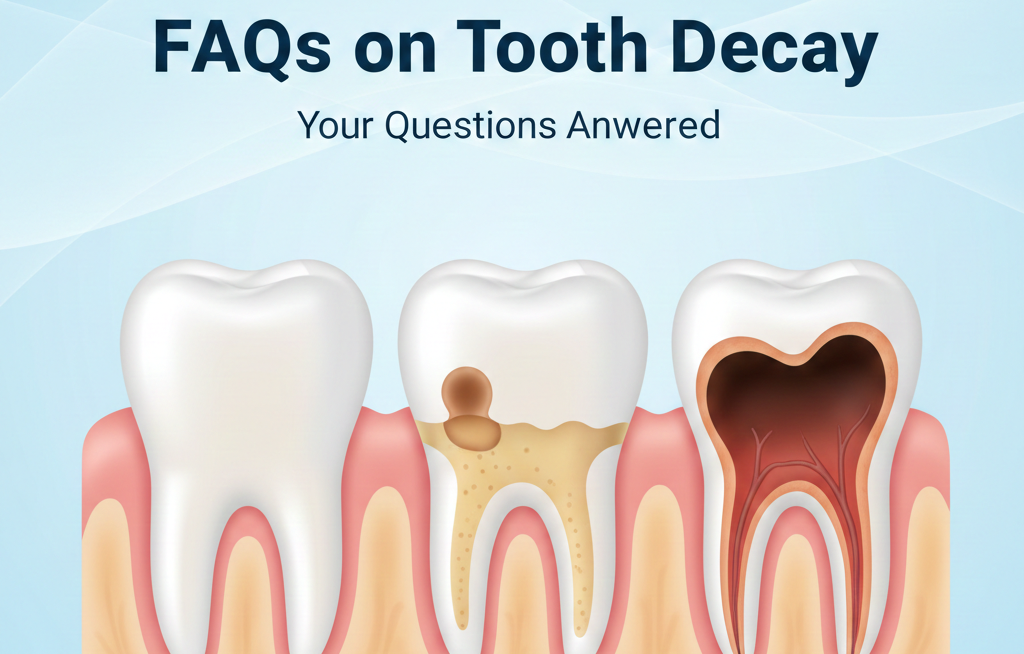
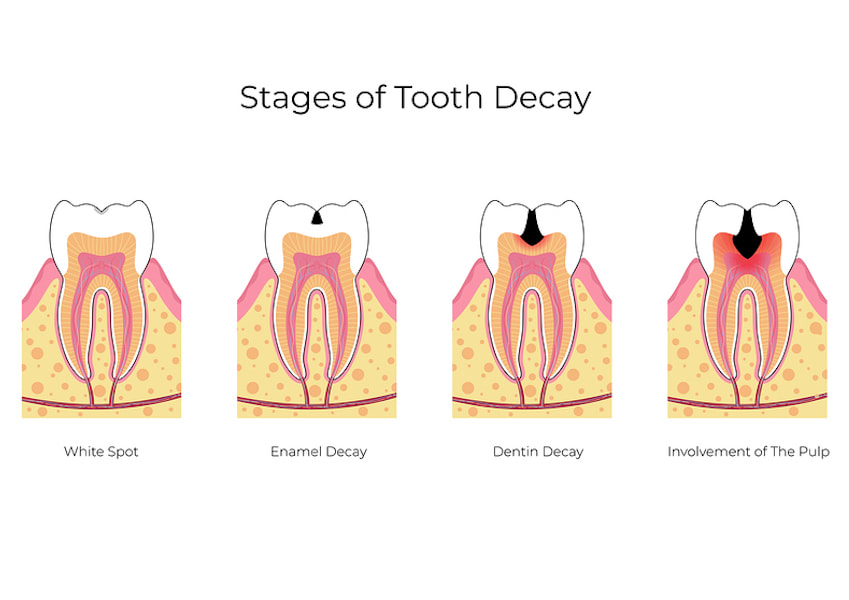
Ans. It is a phenomenon of the inner layer of the tooth, which is also known as tooth enamel. And during the tooth decay process, the bad bacteria produce a type of acid in the mouth that causes demineralisation, which leads to the creation of a hole with pain and infection in the tooth. This tooth decay is also called dental caries or cavities, and if not cured or treated in a timely manner, it can result in permanent loss of a tooth.

Q. 2. What are the Symptoms of Tooth Decay?

Ans. One of the most common symptoms of tooth decay is a feeling of sensitivity in your tooth, especially while consuming cold or hot food and beverages. On the other hand, the other signs of tooth decay are pain, a stain on the tooth, holes or a black spot and bad breath. However, sometimes there are no symptoms visible at the early stage, and later it becomes painful with swelling and infections in the tooth.

Q. 3. What Causes Tooth Decay?

Ans. The bad bacteria in the mouth, while feeding on the sugar and starch from the food or beverage items, produce an acid that erodes the tooth enamel, starting to decay the tooth. And when you do not clean your teeth regularly or properly, or live with poor oral hygiene like not flossing or avoiding rinsing your mouth after food or drinks, then these bacteria aggressively damage the tooth. 

Q. 4. What is the Role of pH in Tooth Decay?

Ans.  pHis playing a crucial role in controlling the oral bacteria in the mouth. When the mouth’s pH drops below 5.5, oral bacteria feed on sugars and start producing acid that dissolves tooth enamel, causing tooth decay. And this pH level is maintained by the saliva to generate a healthy mouth pH (around 7.0). However, acidic food, drinks and bacterial byproducts lower pH, causing mineral loss resulting in tooth decay.

Q. 5. Why Does Tooth Decay Smell?

Ans. As we said, tooth decay is caused by the acid produced by bacteria in the mouth, feeding on the tissues of the tooth. And during this process, the chemicals like Volatile Sulfur Compounds (VSCs), such as hydrogen sulphide, are foul-smelling components. 

Apart from that, as many cavities develop, they trap food and bacteria that create anaerobic pockets, which are also responsible for producing the gases with a bad odour. On the other hand, infections or abscesses due to decay also produce pus, which also contributes to a very strong and unpleasant smell in the mouth.
tooth decay

Q. 6. How to Stop Tooth Decay Pain?

Ans. The tooth decay pain could be highly intolerable; you need to stop this as soon as possible. Though you can visit your nearest dentist in Greater Noida and get the right medicine (painkiller) to stop tooth decay. But if you want to control such pain at home, you can try various home remedies like using clove oil or benzocaine gels, or rinse with warm salt water or apply a cold compress to your cheek. 

Q. 7. How to Prevent Tooth Decay?

Ans. To prevent tooth decay, you need to follow consistent oral hygiene and maintain good food habits. Keep brushing twice daily, especially at night before going to bed for sleep. Apart from that, always use the fluoride toothpaste, floss daily and always rinse your mouth after consuming foods and beverages. 

And to prevent tooth decay, also cut your sugar intake and avoid eating starchy foods. Cleaning the teeth, maintaining the pH level and limiting the sugar will help you to prevent tooth decay. And also keep regularly visiting your nearest best dentist in Greater Noida for oral examination and treatment for teeth.

Q. 8. How to Remove or Reverse Tooth Decay at Home?

Ans. Though the tooth decay or cavities cannot be removed at home, you need to consult with the dentist, who can only diagnose and professionally remove the cavities. But if you managed to spot the formation of cavities at the early stage, you can reverse the tooth decay at home. 

Use the fluoride-based toothpaste and brush twice daily on a regular basis. And also reduce your sugar and starchy food intake by flossing and rinsing your teeth after consuming food and drinks. Apart from that, you can also use the antibacterial mouthwash to strengthen enamel and reverse tooth decay.  

Q. 9. What is The Best Treatment for Tooth Decay?

Ans. The treatment for tooth decay is based on the tooth condition and the severity of the cavities. The early stage of decay can be treated with fluoride gels, varnishes, or rinses to strengthen enamel and reverse the initial decay that starts before a cavity forms. And for the moderate level of tooth decay, a dental filling is used to treat the decay. In this process, the dentist removes the decay and fills the area with suitable material like composite filling, porcelain or amalgam.

On the other hand, for the extensive condition of tooth decay, the crown and bridge is the best treatment for tooth decay. And when tooth decay is in a severe condition or decay is very deep, then root canal treatment is the best treatment to cure such a problem. While in the worst condition, when RCT is also enough to save the tooth from decaying, then extraction is the last resort, with the option to get a new tooth by dental implants.     

Q. 10. What does a Dentist do for Tooth Decay?

Ans.  When you visit Dr Sinha Dental Clinic or any other dentist, he will diagnose the tooth condition and start the treatment process as per the severity of cavities. And during this dental procedure, the dentist will first of all remove the decayed tissues and restore the tooth using fillings like crowns, bridges or root canals as per the severity of the tooth to make it healthy again.    

During this dental procedure, the dentist can use anaesthesia to numb the area around the affected tooth for the least pain. After that, the cavities or pulp removal process is performed, and the infected areas are cleaned. And finally, the tooth is restored with a crown or capping, giving a new life to the tooth affected by decay. 
Dental Bridge and Dental Implant Difference: Which is Better

Dental Bridge vs Implants
Dental Bridge and Dental Implant Difference: Which is Better

Dental bridges and dental implants are two of the most popular dental procedures to get a new tooth in the place of a missing or extracted tooth. However, both are different from each other in terms of their treatment process, cost involved and durability or longevity.

Choosing between these or which one is suitable for you would be possible only when you understand the actual difference between both of them. So, right here we are going to discuss about the difference between dental implants and dental bridges, and which one is better.      

What is Dental Bridge Procedure?

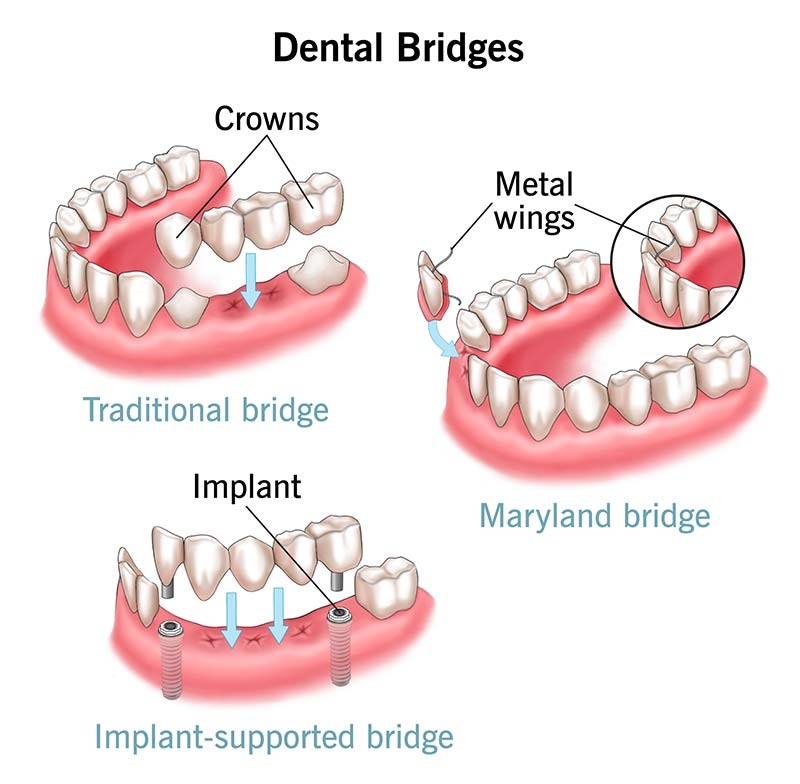
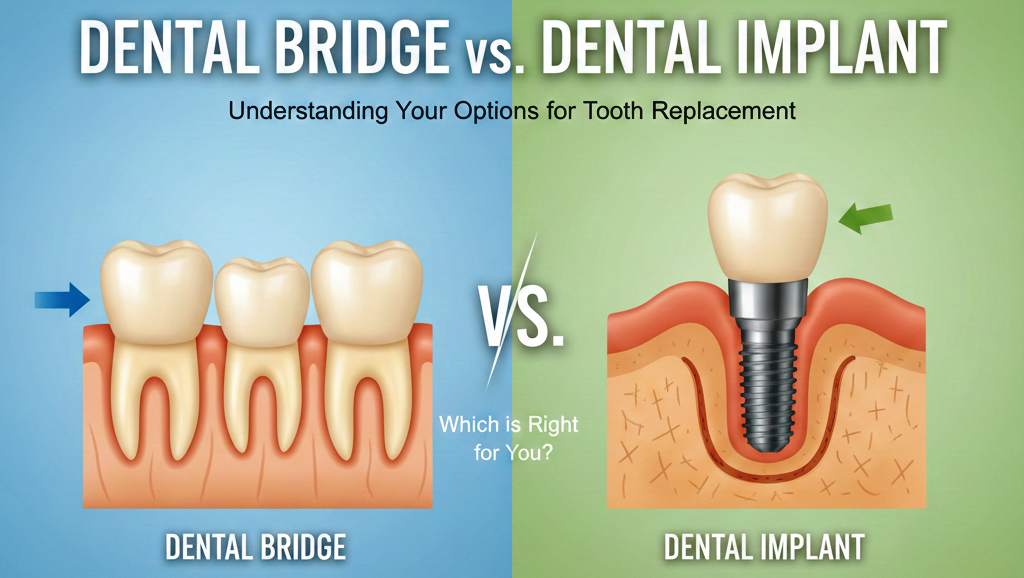
Bridge in the teeth is kind of dental procedure use to create a type of bridge between two missing teeth. Dental bridge fills the gap of missing teeth with new one with the support of other two neighbouring teeth. In fact it is kind of dental crown with three attached with each other, in which two of both ends are capped on the existing teeth creating a bridge for the artificial teeth that called pontics.

Read Here: Types of Dental Procedures Used for Treatment of Teeth Diseases

Abutments are the structures used to support your dental bridge to fill the gap between two teeth. One of the main motives of dental bridge is to cement the new tooth to restore the proper functioning of teeth and make your overall teeth appearance better and aesthetic. 

Dental Bridge Procedure

What is Dental Implant Procedure?

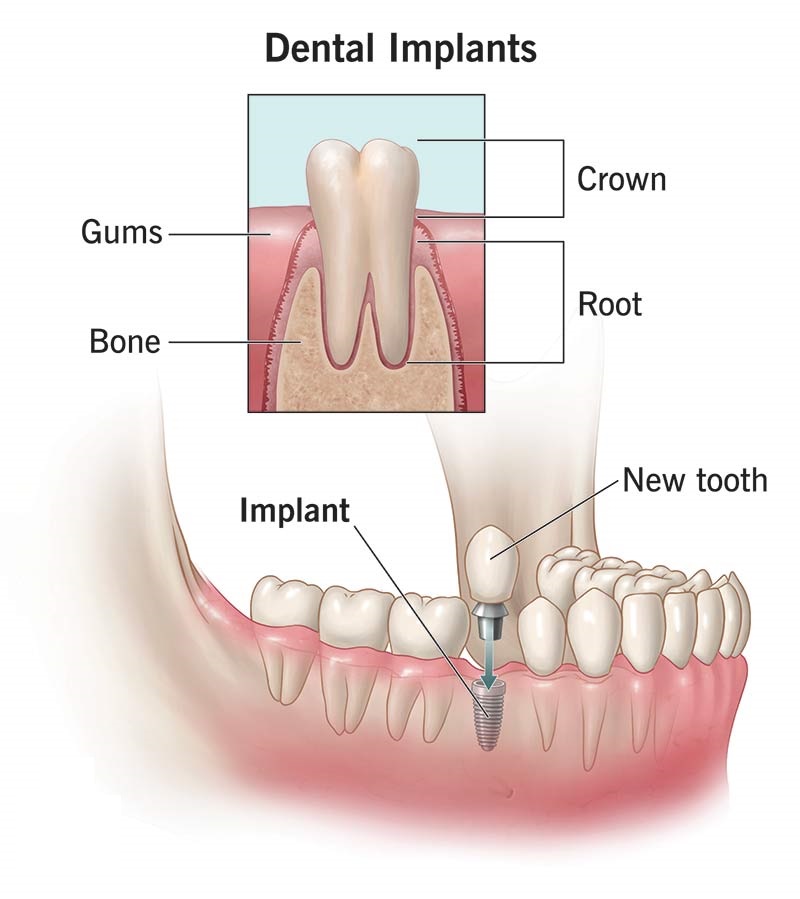
Dental implant is procedure of installing the new tooth in place of missing one. It is a kind of surgical procedure in which dentist uses the titanium post to implant the new teeth covered with custom-made crown. In this dental procedure a new teeth is implanted attached with titanium connected with screws into the threaded post to provide the better strength and long lasting performance.     

Read Here: What is Dental Implantology & How are Dental Implants Done?

Implants are used to provide the natural functioning of the teeth with aesthetic rehabilitation. And one of best advantage of implants is it fuses your jawbone and not going to decayed like your teeth. It can provide the more strength and better functioning of chewing to entire teeth structure. 

Dental Implant Procedure

Difference Between Dental Implant and Bridge:

AspectsDental BridgesDental Implants
DescriptionDental bridge is kinds of bridge create for the missing tooth between two teeth. The other two beside teeth provide support to the new tooth create through a bridge to give a natural look.Dental Implants are process of implanting the new tooth in place of missing or extracted tooth. The implant is different from bridge in terms of installation and treatment procedure followed.  
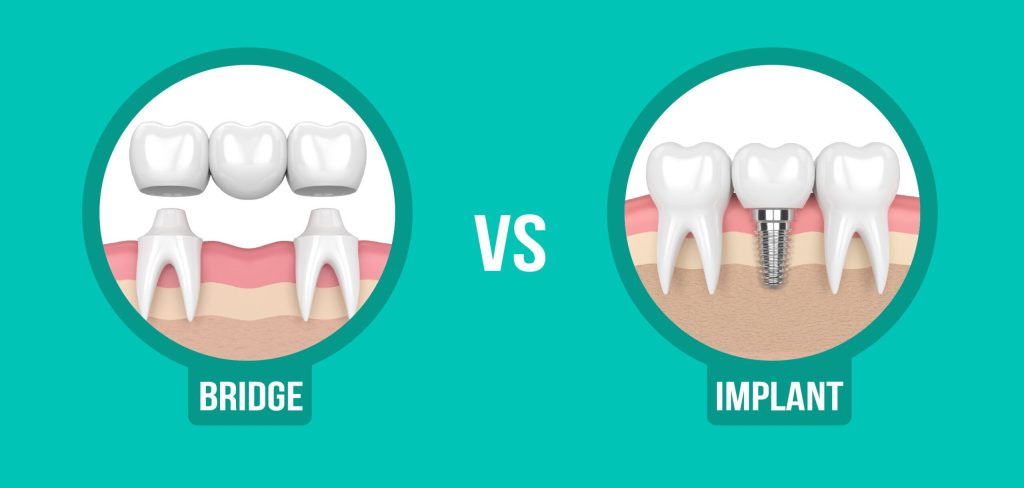
Dental ProcedureA false tooth which also called the “pontic” is used to place through a crown on the other two neighbouring teeth. Compare to implants it is less complicated and don’t require surgeries. A titanium post is surgically placed in the jawbone to provide a strong support to the new tooth. It involves surgical process with more complicated procedure compare to bridges.  
Level of PainLevel of pain in the dental bridges is low or less compare to implants as there is no surgical process involved.The level of pain or discomfort is high compare to bridges, as surgical treatment process is followed here.    
Bone HealthIt can lead to loss of bone, as there is missing tooth and there could be deterioration of the jawbone over time.It prevents the loss of jawbone by providing the stimulation to the jawbone and preventing bone resorption.
Effect on Neighbouring TeethBoth sides of neighbouring teeth are used to modify or alter to provide support for the bridge. In this process, don’t need any such modification or alteration to any other neighbouring teeth.
AppearanceThe look and feel of teeth installed through bridges may not look natural like implants.The tooth installed through implants look more aesthetic with natural look and feel.  
DurabilityBridges may last up to 5 to 15 years depending on your teeth condition and oral care.Implants last longer compare to bridges and last till the lifetime if properly cared. 
Maintenance To maintain bridges you need special cleaning especially around the bridges with extra precautions.It require regular brushing, flossing or professional cleaning at the dentist on the occasional basis.   
Cost of TreatmentThe cost of treatment is lower than implants, but may involve recurring costs due to longevity.The cost of treatment is high compare to bridges but potentially lower in the long-term performance.
AdvantagesLess time, cost, complications and pain involves with faster recovery and functioning of tooth. It is long lasting dental procedure providing the natural look and requires less care or maintenance.
DisadvantagesLess durable or lower longevity with more artificial look and feel or need extra care and precautions. It is a costly surgical procedure with more complicated, time taking and painful treatment process. 
Suitable For PeopleIt is suitable for people having missing tooth with healthy teeth or implants are available on either side to anchor them to fill the gaps for maintaining the bite balance or restore the chewing. It is suitable for people looking for a durable, natural-looking tooth to replace the missing tooth but having the healthy gums, sufficient jawbone, and good overall health to go through the surgeries.

Dental Bridge or Implant, Which is Better?

The dental bridges are quicker option with less cost of treatment or can be installed easily with fewer complications. However, to perform this alteration of other teeth is also required and it is not durable as much as implants, and may need replacement sooner or later. 

While on the other hand, dental implants may involves the high cost of treatment due to complicated surgical procedure, but can give a strong and durable tooth. It can provide the better and stronger chewing experience with more aesthetic and natural look while maintaining its functionality. 

Why is an Implant Better than a Bridge?

Dental implants are better option compare to dental bridges in terms of providing the long-lasting and natural looking teeth structure. The dental bridges can last up to 5 to 15 years, while implants can last more than 30 years making better option for the people don’t want to visits at dentist for new tooth.  

Read Here: Why Dental Implants Are Important and its Benefits?

A titanium post is used to install the new tooth through implants; it is better option compare to bridges, where two neighboring teeth are used to support the new tooth. And bridges are not stronger as much as implants and you might need frequent visits to check the crown and its functionality. 

Difference Between Dental Implant and Bridge

Bridges could be a cheaper option or are less invasive but can strain supporting teeth and don’t prevent bone loss below the missing tooth, leading to potential issues later. While implants involves high cost of treatment but prevents the bone loss and potential damage to adjacent teeth.

Conclusion

Dental implants and dental bridges both have their own pros and cons and you can choose them as per your needs, budget, and long-term goals. However, when you visit at your nearest dental clinic for dental bridges or dental implants services in Greater Noida, the dentist will suggest which is suitable for you.  However, if you are looking for affordable and quicker solution for your missing teeth you can choose the dental bridges but dental implants can be better option if you can afford and looking to invest in permanent dental solution with more aesthetic look and feel for your mouth.

Dental Crown & Filling: Do You Need Crown After Dental Filling?

dental filling and crown
Dental Crown & Filling: Do You Need Crown After Dental Filling?

Dental procedures in dentistry are performed as per the patient’s teeth condition and requirement at that point in time. However, there are several dental procedures that are performed individually, but some of them are not completed, or you can say not become successful without performing other procedures.

A dental filling is a dental procedure that is sometimes completed without any further treatment process or dental procedures. However, sometimes after filling, the dentist also performs the dental and bridge. So right here today we are going to discuss about dental fillings and crowns.      

When you need only a dental filling, or when you need only a dental crown and when you need both a crown after filling. Let’s start with their introduction, their individual roles in dentistry and when both are needed.  

What is a Dental Filling?

When your teeth are affected with the initial stage of cavity or decay and cracks, the dentist performs this procedure. In the dental filling, the dentists remove the cavity or decayed part and clean the surface to remove any deposited substance.

And after removing all these, the dentist performs the dental filling process. And there could be different types of materials that can be used, like composite (tooth-colored), amalgam (silver), gold, or porcelain to restore the tooth’s shape, function, and prevent any further decay. 

When Do You Need a Tooth Filling? 

The dental filling can be performed in various situations, but usually dentists do this when there is a cavity in the teeth or the tooth is decayed. However, when you have a sensitivity problem or if there is any hole or pit sign in your teeth, you need a dental filling.

In dental filling, after cleaning and removing the cavities, the space left is filled with suitable materials. The filled material forms a solid substance and protects your teeth from additional deterioration. However, you can choose the filling material as per the availability with the dentist and your affordability.

dental filling and crown

What is a Dental Crown?

It is a kind of helmet, or you can say a head covering cap, to protect your tooth from pressure and restore its appearance, shape, size and strength. This crown is used to cover the teeth from the gumline to cover the entire visible tooth, protecting it from decay, cracks, and weak teeth.

In a dental crown, there are different types of materials used, like porcelain/ceramic, metal alloys, and porcelain-fused-to-metal or composite resin. The type of material need to use in the dental crown depends on the condition of the tooth and the affordability of the patient. 

When do you Need a Dental Crown?

The dental crown is one of the popular dental procedures usually performed when your tooth is cracked or broken or badly decayed. And in some situations, when your teeth are worn down after performing a critical dental procedure like a root canal, then a crown is required to cap such a tooth.

In fact, the dental crown is used to restore the strength of the teeth and give them a shape and the right functionality to cover the dental implant or broken teeth or discoloured teeth. And most importantly, it gives a natural look to a treated tooth with the strength to bite and chew food without any issue.    

Also Read: What is a Composite Filling: How it is Done & Take Care of it?

When Do You Need a Crown Over a Filling?

The crown is usually done after most of the filling dental procedure, as filling is not strong enough to resist the biting or chewing activities of the teeth. While filling is just used to fill the hole or gap in the cavity, a crown is used to cover such filled teeth. However, let’s find out exactly when you need a crown after filling or why filling is not enough for such treated teeth.      

Major Cavities: When your tooth is decayed with large major cavities and a large area of the tooth is affected by the cavity, then you need a crown to protect the weakened filling area on your tooth.

Multiple Fillings: When your teeth have undergone multiple filling procedures, you need a crown to protect the layer. In fact, the tooth filled multiple times makes its wall fragile, but a crown can protect it.

After Root Canal: Root canal treatment (RCT) is one of the most critical dental procedures in the dentistry that is performed to treat a tooth badly damaged from the roots. In fact, after RCT, the tooth no longer has its nerve and blood flow which makes the tooth fragile, and that can be protected through a dental crown. 

Gaps Between Teeth: If your two teeth have extra gaps, they can be filled with the dental crown. The gap between the teeth provides enough space to cover its surroundings. The dental filling can also be applied to fill such gaps, but it would not be long-lasting unless it is covered with a crown.

Cracked or Broken Tooth: It is one of the most common reasons the dental crown is applied to cover a broken or cracked tooth. Covering such fractured tooth with a crown can hold the tooth’s structure and stop further spreading cracks, and prevent further damage or exposure to nerves.  

Severely Damaged Tooth: And if your tooth is badly damaged due to injury or for any other accidental reasons, then after performing the filling, a dental crown is necessary. It will protect the tooth from external forces and provide a natural strength and feeling to bite or chew food items.   

Summing-up

The dental filling and dental crown are both the type of dental procedure usually performed collaboratively. However, the dental filling is performed when your tooth is affected by a cavity, decay or plaque. The dentist removes such cavities, and to fill the space, the filling process is performed. And there are different types of materials, like composite or metal-based fillers, which are used in this procedure. 

On the other hand, a dental crown is a dental procedure in which a damaged or treated tooth is covered with a crown to protect it and provide natural strength. Usually, a crown is performed when a tooth is broken, damaged, cavity-affected or after root canal treatment. And after most of the filling, the crown is necessary to uphold the strength and functionality of the tooth while giving a natural look.   If you are looking for any of these dental procedures or need both of them, dental filling and dental crown in the Greater Noida area, you can visit your nearest one of the best dental clinics in Greater Noida. Here you can get the best dental care and treatment at minimal visits, with the least pain and at reasonable charges.   

Difference Between Veneers and Crowns: Which is Better

Crown-vs-Veneer
Difference Between Veneers and Crowns: Which is Better

Your teeth affected by any type of dental problem can be treated with a suitable dental procedure. Crowns, bridges, veneers, dental implants, and root canals are the most popular dental procedures you can get, depending on your dental problem. However, sometimes it becomes difficult to know which one is suitable for you, though the dentist can tell you better, but you also need to be aware of such treatment.

Veneers and Crowns are also one of the most popular dental pressures used to cover your teeth, giving an aesthetic look with their own properties and functionality. Both are used for dental restoration, but they are different from each other in terms of their positioning and covering the teeth.

veneers vs caps

Hence, right here we are going to discuss about the difference between veneers and crowns. It will help you to understand the core differences and which one is better or suitable for your teeth.  

What is Dental Veneers Treatment?

A dental veneer is a thin layer, maybe around 1mm thick, made of porcelain, used to fix on your front teeth. This dental procedure is usually applied in cosmetic treatments, such as when you need to improve the shape and size of your teeth to make them uniform.

Veneers are usually made of porcelain, which, when applied, makes your teeth look more natural and aesthetic. Apart from porcelain, you can also get the composite resin-made veneers that can be a cheaper option, but it is not long-lasting and highly durable. 

What is Dental Crown Treatment?

Dental crowns are a type of capping or headpiece that is used to cover the teeth entirely. This dental procedure is performed to cover the tooth and restore its size, shape, and strength while improving its appearance. And when a crown is placed on your tooth, it fully covers the entire visible portion of the tooth above your gum line, making it look more appealing and natural.    

Also Read: What are the Advantages & Disadvantages of Dental Implants

The crown is usually placed on a tooth when your tooth has a hole due to a cavity or decay, as the dentist removes the decayed part and places the crown to protect your tooth from further decay. The crown is not only placed to cover your decaying tooth, but it also gives your tooth a shield and strength to use your tooth normally for chewing and other functionality. 

What’s the Difference Between a Crown and a Veneer?

The crown is different from veneers in terms of its placement on your teeth, the type of material and the thickness of the same. Apart from that, based on your teeth condition, your affordability and preference, the dentist will apply any of these types of dental procedures to your teeth. However, there are certain other key differences listed below that you should know to understand their applications. 

veneers vs caps

Difference Between a Veneer and a Crown:   

AspectsDental VeneersDental Crowns
Purpose of Use  Veneers are used to improve the appearance of a tooth.  A crown is used to restore and protect a damaged tooth.
PlacementA veneer is applied to cover the front surface of your tooth.  A crown is placed from the top to cover the entire tooth.     
Thickness  Veneer is thin, around 1 millimetre (mm) in thickness.  The Crown is thick, around 2 mm, thicker than the veneer.    
Material Type  The materials used in making veneers are either porcelain or composite resin.  A crown can be made of metal, zirconia, porcelain or porcelain-fused-to-metal.  
Durability  Veneers are less durable than a crown and prone to hard biting or chipping.  Crown is more durable and designed to resist the strong bite or chewing forces.  
Appearance  A veneer looks more aesthetic and natural in an appliance than a dental crown.  Crowns can also give a natural look to your tooth, but not as much as veneers.      
Advantages  Veneers are used for cosmetic treatment that requires less tooth alteration at the time of their application.  Crowns are a complicated but long-lasting dental procedure that requires restoration of the tooth before placing the crown.   
Disadvantages  Veneers are less durable than crowns and need extra care and precautions while chewing.  Crowns are more durable than veneers, but also need care and precautions to last long.
Costing  The cost of veneers is less than that of a crown, as it is a simple cosmetic dental procedure.  The cost of a dental crown is much higher than that of veneers due to the restorative function.   
Lifespan  The life expectancy of veneers is typically around 7 to 10 years with proper care.  The lifespan of a dental crown can extend between 10 and 15 years with usual care.
Suitable for  The veneer dental procedure is suitable for improving your tooth’s appearance.  A crown is suitable when you need to restore or protect a broken or damaged tooth.  

Conclusion: Crown or Veneer: Which is Better? 

Though a crown and veneer are both types of dental procedures used to improve your smile and the function of your tooth. However, the crown and bridge is better for you if you want to protect your damaged, broken or decayed tooth. On the other hand, veneer is better when you need a cosmetic improvement to cover your chipped or cracked tooth, covering only the front surface while preserving the natural structure.    

veneers vs caps

Also Read: What is a Composite Filling: How it is Done & Take Care of it

However, choosing between a crown and veneers is not only about your choice, but it is also about your tooth’s condition and the extent of damage that can be restored with a crown or veneer. And one of the best dentists in Greater Noida can tell you better which one is suitable for you. Hence, if you need any one of them, book your appointment and visit Dr Sinha Dental Clinic for the best dental treatment in Noida.